If Someone Dont Love You Nomore Can They Love U Again
Introduction
Love and hate are important man affects that are of long-standing interest in psychology. Increasingly, empirical enquiry has been carried out on the human relationship between love and hate. Still, traditional psychological theories have mainly focused on love, especially romantic love. These include Sternberg's (1986) triangular theory of dear and the three-stage model of love (Fisher, 1989; Fisher et al., 2006). Honey has been divers as an action (Swensen, 1972), attitude (Rubin, 1970), experience (Skolnick, 1978), and fifty-fifty equally a prototypical emotion (Fehr and Russell, 1991; Post, 2002; Sober, 2002; Wyschogrod, 2002). Collectively, these definitions suggest that beloved is a multi-faced phenomenon (Ekman, 1972; Izard, 1977; Tomkins, 1984). Hate, inside the context of a romantic relationship, arises mainly from a relational expose. Researchers have proposed a concept related to romantic hate, romantic jealousy, which describes the negative attitudes, anger, and fright associated with having a relationship partner (Yoshimura, 2004).
Love and hate are related to each other in a complex mode; the methodological approaches used by previous researchers accept limited effectiveness in exploring the intricate relationship between love and hate. In add-on, in that location has been little inquiry on the psychological mechanisms that could explain the interrelations betwixt love and hate. Therefore, our report investigates how these two affects are related. To pursue such a research objective, i must consider how all-time to induce varying levels of feelings of love.
Previous studies have institute that attraction is a crucial condition for the development of romantic love (Cutler et al., 1998; Braxton-Davis, 2010; Miller and Maner, 2010). Similarity, rather than complementarity, plays a key role in attraction (Berscheid and Reis, 1998; Luo and Klohnen, 2005; Hudson et al., 2014). Many aspects of similarity have been studied in relation to attraction. In the current study, we focused on similarity in ideologies. That is, persons with like ideologies (divers here in terms of values and interests) tend to class longer lasting and more harmonious relationships (Buunk and Bosman, 1986; Lemay and Clark, 2008). Ideological similarity also implies commonalities in behaviors which farther contribute to mutual allure in the context of romantic honey (Schafer and Keith, 1990). From this perspective, similarity may exist a key factor that influences the caste of love. In addition, researchers institute that differences in excellence levels, such as those relating to ability and achievement, between partners would also be an important factor influencing romantic relationships (Conroy-Beam et al., 2016).
In the present study, we manipulated the level of similarity and the level of excellence to induce different levels of love. That is, nosotros concurrently varied the levels of similarity and excellence of different targets. We explored whether participants felt stronger love for a target who was more similar to themselves when the targets and participants were of the aforementioned level of excellence. Additionally, we were likewise interested in whether participants have dissimilar emotional reactions toward different target persons in the context of romantic love and hate.
We examined two research questions in the electric current enquiry. Offset, would at that place be greater feelings of love betwixt two persons if they were more similar to each other? 2nd, under certain conditions, does a person's love generate a corresponding level of hate when negative events occurred to his or her romantic partner?
In this study, we implemented a prototype similar to what has been used in previous enquiry (Takahashi et al., 2009), and adapted the scenario method to induce love and hate. The characters in the scenario included one protagonist and three targets. Participants read the scenario and imagined that they were the protagonist and were in a romantic relationship with one of the target. Nosotros induced dissimilar levels of beloved past manipulating the caste of similarity (e.yard., values and interests) and excellence (eastward.g., power and achievements) between the protagonist and target persons in the vignettes. We likewise induced detest using vignettes that showed target persons betraying the protagonist, such as going on dates or having affairs with people of the opposite-sex. We hypothesized that greater similarity betwixt a participant (protagonist) and a target would be associated with greater feelings of dearest, and that when negative events occur with the protagonist's romantic partner, the target would be associated with greater feelings of detest.
Materials and Methods
Participants
Sixty volunteers, recruited from different colleges, participated in the experiment. 1 participant had misunderstood the instructions and was thus excluded from the analyses. As a issue, the concluding studied sample consists of 59 participants (xxx men, 29 women, age M = 20.2 years, SD = 1.five). None of the participants reported any previous diagnoses of psychiatric or neurological illnesses. Roughly 18% of the participants said they were looking for a relationship, 33% were in a human relationship, 24% had experienced a break-up, and the remaining 25% had non been in whatsoever relationships. The study was approved by the Ethics Committee of the School of Psychology at South Red china Normal Academy. Each participant had provided written informed consent prior to participating in the experiment. They were as well given small-scale tokens of appreciation for their participation.
Materials
The vignettes used in the present experimental image were adapted from a previous study that investigated the neural correlates of green-eyed and schadenfreude (Takahashi et al., 2009). The vignettes were modified to fit the present romantic dearest context, according to the previous definitions of love (Hatfield and Sprecher, 1986; Schafer and Keith, 1990). The people in the vignettes included one protagonist and three targets (i.eastward., targets A, B, and C) corresponding to 3 manipulated conditions (see Supplementary Fabric). Participants were asked to study and understand the vignettes thoroughly and to imagine themselves as the protagonist in the vignettes. Target A was described as a person of equal level of excellence and high similarity to the protagonist, target B as equal level of excellence and low similarity to the protagonist, and target C every bit low level of excellence and low similarity to the protagonist (target C). See Supplementary Table S1 for details.
Questionnaire
We used the fifteen-item Passionate Honey Scale (PLS; Hatfield and Sprecher, 1998) to measure the degree of love evoked by each participant in the vignettes. An example of an item in the PLS is, "I would rather exist with him/her than anyone else…" Participants rated each detail according to the degree of passionate love they perceived (ane = none; ix = extremely passionate love). The PLS is suitable for individuals who are and are not in a relationship, and for individuals who have never been in a romantic relationship (Hatfield and Sprecher, 1986; Aron et al., 2005). The reliability and validity of this scale have been established in previous studies (Hatfield and Sprecher, 1986; Fehr, 1988; Hendrick and Hendrick, 1989; Fehr and Russell, 1991). Cronbach'due south blastoff coefficient was 0.94 in the nowadays written report.
Procedures
Learning Materials
The experiment consisted of two parts. Nosotros induced feelings of honey toward the targets in the participants (the protagonists) in Part i (Figure 1), and feelings of hate toward the targets in Function 2 (Figure two).
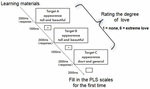
Figure 1. Part 1 consisted of three phases: studying the materials, rating on the computer, and completing the PLS. This effigy presents a schematic delineation of the stimuli and rating job blueprint of Part ane (dearest). Beginning, a fixation cross hair was presented for g ms followed by the experimental stimuli (Lover A, Lover B, and Lover C) that were displayed for 2000 ms or until response. The top line in each stimuli-containing rectangle indicated a target person, the heart line indicated the domain of comparison (excellence and similarity), and the bottom line indicated the specific traits in these ii domains.
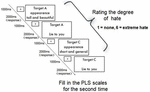
FIGURE 2. Office ii consisted of two phases: rating on the computer and completing the PLS. This figure presents a schematic delineation of the stimuli and rating task design of Part 2 (detest). Specific traits of Lover A, Lover B, and Lover C were presented every bit in Part 1. Each trait was followed by a subsequent negative effect, which was presented for 2000 ms or until response. The top line indicated a target person, and the bottom line indicated a negative issue. A 1000 ms inter-stimulus interval was interleaved between each trait and negative issue.
First, participants were asked to read a story and imagine that they were the protagonist (see Supplementary Material). Next, the participants were asked to recall relevant key details about themselves past responding to sentences get-go with "I am…" Following this, participants were instructed to read iii vignettes describing three different situations. Each vignette involved the protagonist and three targets. Participants were asked to recall the information relating to each target through free recall. Participants were then asked to imagine that they were in a romantic relationship with the target.
Ratings and Measurements
Nosotros used East-Prime number 2.0 to nowadays the items in a random society [nosotros included 15 cadre items from each vignette into the reading materials of each target (run across Supplementary Table S1)]. Afterward the participants studied the materials, they completed the rating task on the calculator and then completed the PLS in both Part 1 and Part two. Participants gave one love score per item per target person in Part one and 1 detest score per negative effect per target person in Part ii, as well as two PLS scores before and after the negative events.
In Function ane, we asked participants to imagine themselves as the protagonist when reading the scenario, and so rate each trait presented in terms of how much love they felt toward a target based on the presented features of the 3 targets (one = none; half dozen = extreme love). Later that, we used the PLS to measure out participants' feelings of love with the three targets.
In Part two of the experiment, the groundwork characteristics of A, B, and C were unchanged; nonetheless, we created vignettes in which the targets betrayed the protagonist, for example by having an affair with someone of the contrary sex activity (meet the negative events in Supplementary Table S1). Participants were then asked to rate how much hate they felt toward A, B, and C (ane = none; 6 = extreme detest). Upon completion of Part ii, participants completed the PLS again to assess their feelings of love toward the three targets.
Assay
Nosotros used several analyses to exam our hypotheses. The scores from dear ratings, hate ratings, and the PLS items were averaged within subjects prior to the analyses. Specifically, we used one-way repeated measures of analysis of variance (ANOVA) to examination for differences in participants' love ratings, hate ratings, and PLS scores for targets A, B, and C; these analyses were conducted for scenarios with and without betrayal (Office i and 2). Simple effect tests were performed when the interaction event was significant.
Additionally, we used a 3 (target: A, B, and C) × 2 (time: before vs. after) 2-way repeated measures ANOVA to clarify the degree of love level perceived by the protagonist in relation to the iii targets before and after the negative events. Adjacent, we used a 3 (target: A, B, and C) × 2 (impact: honey vs. detest) two-way repeated measures ANOVA to clarify the relationship between the love and hate scores. Tests of unproblematic principal effects were performed when an interaction outcome was statistically pregnant. In add-on, nosotros used Pearson's correlation assay to exam the correlations between scores for dearest and hate. Subsequently, we used fractional correlations to examine the clan between honey and detest controlling for participants' gender and age.
Results
Caste of Beloved
Across the different weather (targets A, B, and C), the results of the one-mode repeated measures ANOVA revealed significant differences in perceived feelings of love [F(ii,116) = 985.710, p < 0.001, η2 = 0.944]. Further analyses of the elementary principal effects showed that the degree of love toward target A (v.53 ± 0.48) was significantly higher than that of target B (4.52 ± 0.54) [F(i,58) = 177.796, p < 0.001, ηtwo = 0.754], and the degree of love toward B was significantly higher than that of target C (i.66 ± 0.45) [F(ane,58) = 977.526, p < 0.001, η2 = 0.944].
Additionally, across the unlike targets, the results of the one-fashion repeated measures ANOVA revealed significant differences in participants' PLS scores of the three targets [F(ii,116) = 450.352, p < 0.001, η2 = 0.886]. Further analyses of the simple principal furnishings showed that the degree of passionate dearest toward target A (109.73 ± 11.fourscore) was significantly college than that of target B (93.46 ± xiv.59) [F(1,58) = 60.263, p < 0.001, η2 = 0.510], and the degree of passionate love toward target B was significantly higher than that of target C (38.39 ± xx.40) [F(1,58) = 519.537, p < 0.001, η2 = 0.900].
Caste of Hate
Beyond the different targets, the results of the one-way repeated measures ANOVA revealed significant differences in the degree of hate subsequently the negative upshot manipulation [F(2,116) = 229.64, p < 0.001, η2 = 0.798]. Further analyses of the elementary principal effects showed that the degree of detest toward target A (v.25 ± 0.57) was significantly higher than that of target B (four.84 ± 0.55) [F(1,58) = 34.768, p < 0.001, η2 = 0.375], and the degree of hate toward target B was significantly college than that of target C (3.02 ± 0.98) [F(1,58) = 216.921, p < 0.001, ηii = 0.789].
Across the different targets, the results of the one-fashion repeated measures ANOVA revealed significant differences of the overall PLS scores after the negative event manipulation [F(2,116) = 316.544, p < 0.001, ηtwo = 0.845]. Further analyses of the simple main effects showed that the PLS score for target A (88.95 ± 22.00) was significantly higher than that of target B (71.97 ± 21.83) [F(1,58) = 63.119, p < 0.001, ηtwo = 0.521], and the score for target B was significantly higher than that of target C (27.81 ± 14.39) [F(ane,58) = 333.357, p < 0.001, η2 = 0.852].
The iii (targets: A, B, C) × 2 (time: earlier vs. later) 2-way repeated measures ANOVA revealed a significant target × fourth dimension interaction [F(2,116) = x.432, p < 0.001, η2 = 0.152] on PLS scores. Further simple chief outcome analyses revealed that subsequently the negative result manipulation, participants' love scores for target A was significantly lower than earlier the manipulation [A-Earlier: 109.73 ± eleven.lxxx, A-Later: 88.95 ± 22.00; F(1,58) = 74.822, p < 0.001, η2 = 0.560]. Similarly, participants' love scores for target B [B-Earlier: 93.46 ± 14.59, B-After: 71.97 ± 21.83; F(one,58) = 68.179, p < 0.001, η2 = 0.540] and target C were too significantly lower than earlier the manipulation [C-Earlier: 38.39 ± twenty.forty, C-Afterwards: 27.81 ± fourteen.39; F(i,58) = 27.842, p < 0.001, ηtwo = 0.324].
Love and Hate
The 3 (targets: A, B, C) × 2 (bear upon: honey vs. detest) two-mode repeated measures ANOVA revealed a significant target × affect interaction [F(two,116) = 95.357, p < 0.001, η2 = 0.622]. Farther simple outcome analyses found that participants' honey of target A was significantly higher than that of hate, fifty-fifty if they were betrayed by target A [A-Love: five.53 ± 0.48, A-Hate: v.25 ± 0.57; F(i,58) = 17.889, p < 0.001, η2 = 0.236]. Conversely, participants' love for target B was significantly lower than that of detest [B-Love: four.52 ± 0.54, B-Hate: iv.84 ± 0.55; F(1,58) = xiv.652, p < 0.001, η2 = 0.202]. Similarly, participants' love for target C was also significantly lower than that of hate [C-Honey: 1.66 ± 0.45, C-Hate: 3.02 ± 0.98; F(1,58) = 102.933, p < 0.001, η2 = 0.640] (Effigy 3).
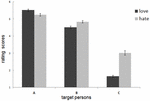
FIGURE 3. The love and hate level of all participants in response to the 3 (targets: A, B, C) × 2 (affect: beloved, detest) two-ways repeated measures ANOVA revealed a significant target × impact interaction. Fault confined represent +1 standard error (SE). Participants' degree of beloved for A (excellent and high similarity with the participants) was still higher than detest after negative events occurred, only the tendency for B (excellent and moderate similarity) and C (low excellence and low similarity) is opposite.
Furthermore, the Pearson correlation analyses showed significant relationships between participants' love and hate toward target A (r = 0.55; p < 0.001). Participants' love and hate toward target B (r = 0.29; p < 0.05). Nevertheless, the correlation between participants' dearest and hate toward target C was not significant (r = 0.12; p > 0.05). The corresponding fractional correlation analyses revealed like results (A: r = 0.48, p < 0.001; B: r = 0.27, p < 0.05; C: r = 0.12; p > 0.05).
Discussion
This study used an experimental paradigm to study the relationship between romantic dear and hate. The electric current study provided support for a link between the two affects and insights into the influence of similarity in romantic relationships. Nosotros constitute that people have dissimilar emotional reactions toward dissimilar target persons in the context of romantic dearest and detest. The relationship betwixt romantic love and detest was revealed to be more complex than expected.
First, our results showed that feelings of love were influenced by similarity. That is, individuals, who were experimentally induced to experience feelings of beloved, felt stronger beloved toward someone of the opposite sex who was similar to them, thus, supporting our first hypothesis. Previous studies have examined whether similarity or complementarity played a more vital role in mutual attraction (Berscheid and Reis, 1998) and concluded that the former was more of import. This view has likewise been supported past research looking at mate preferences (Luo and Klohnen, 2005) and quality of marital relationships (Hudson et al., 2014).
Previous studies had more often than not recruited couples or partners who were already in a human relationship, and there is little direct evidence on whether the similarity of the ii individuals had a crucial role in the evolution of a romantic relationship. A contempo study (Conroy-Axle et al., 2016) reported that mate value discrepancies predicted human relationship satisfaction. To some extent, they considered the equivalence in social status between both partners to exist an of import gene relating to relationship satisfaction. In our study, however, when the participants were presented with two potential partners equal to them in excellence, participants perceived greater love for the one who was more similar to themselves. Relatedly, similarity as well played an important role in mate selection. Our findings complemented the findings of other inquiry in this area. Individuals who were similar to each other hands formed skilful impressions of each other inside a brusque time. This finding combined with results of previous studies suggests that similarity plays a vital part in attraction, regardless of situations involving "love at showtime sight" or impressions based on long-term exchanges.
Second, we plant significant associations betwixt romantic love and detest in the context of a romantic relationship. When presented with negative events with 3 unlike target persons, participants well-nigh hated the person whom they had loved the most previously. Therefore, love and detest are indeed related. Every bit Alford (2005) proposed, hate is an false of love and likewise a type of relationship with others and oneself. That is, in managing their relationships with others, people are at the same fourth dimension managing themselves and their psyches (Alford, 2005). In the context of an individual's love and detest, when the human relationship one had developed with a particular partner was destroyed, the romantic love consequently turned into hate. Especially from the perspectives of immature couples in romantic relationships, hate is besides a reflection of love.
The relationship betwixt love and hate tin can be explained from different perspectives. Romantic hate may be rooted in romantic jealousy. Previous research proposed emotional jealousy and cognitive jealousy as constituents of romantic jealousy. Emotional jealousy reflects the anger and fright of the individual in honey, while cerebral jealousy mainly relates to the individual's negative attitude to lovers (Yoshimura, 2004). Therefore, we speculate that it is a lover's expose that causes acrimony and other negative emotions, resulting in hate. Moreover, cognitive jealousy is directly related to relationship dissatisfaction between lovers (Elphinston et al., 2013). Previous studies take as well constitute a positive relationship between romantic dearest and jealousy. That is, the more one loves a person, the more sensitive one becomes when encountering threats to the human relationship (Mathes and Severa, 1981; Orosz et al., 2015). Thus, individuals feel more beloved and more hatred toward the same lover.
The observed phenomenon of "the deeper the love, the deeper the hate" may also be attributed to the perception of equity imbalance. Researchers accept proposed the concept of "perception of equity" based on equity theory and state that disinterestedness can be achieved by changing one's perception of investments in the relationship or its results (Walster et al., 1973). According to equity theory, disinterestedness is calculated from both the individual'southward inputs and the resulting outcomes (Hatfield et al., 1979). Thus, in our context, the more i loves a person, the more psychological investment one makes. Yet, when there is an imbalance between the individual's inputs and outcomes, the perception of equity is lost, thus, resulting in a change of perception between hate and dearest.
At the same fourth dimension, our results showed a significant interaction between targets (A vs. B vs. C) and affects (love vs. detest). Farther analyses revealed that an individual's degree of love for target A (equal excellence and high similarity with the protagonist) is still higher than the degree of hate subsequently negative effect manipulation, just the results were reversed for target B (equal excellence and depression similarity with the protagonist) and target C (diff excellence and low similarity with the protagonist). In other words, although the three targets were associated with the same negative events, the level of hatred varied across the three targets. If, initially, the private loved the target the most, the degree of love is still college than that of detest afterward the negative event. Withal, when the individual did non love the target as much initially, the degree of dearest would be markedly lower than that of hate.
These results illustrate the complexity associated with romantic love and detest. People have different emotional reactions toward different target persons in the context of romantic love and detest. For the person whom one loves the well-nigh or even hates, love may still be dominant in the context of betrayal. This detest is a reflection of love and a feeling of sorrow. Even so, for the person ane does not dearest, feelings of hate are stronger than those of beloved. This detest maybe has its roots in the moral dimension, which mainly business social judgments about the quality of a person. This is why people experience such pain upon betrayal in a romantic relationship.
Graham and Clark (2006) found that individuals who wait at a relationship equally "all good" or "all bad" have lower self-esteem compared to others. These individuals also take long-term concerns well-nigh whether their partners are willing to accept them in a closed human relationship. The authors proffered this as the reason backside love and hate, and that this phenomenon could be observed in whatever relationship. Needless to say, the complex precursors of love and detest tin be interpreted in many ways. Perhaps every bit some of the most ubiquitous emotions, people need to embrace and explain love and hate objectively and rationally. Although we study the nature of love and detest from a rational point of view and from an emotional perspective to explain the precursors of these two bones emotions, humans are emotional beings.
In summary, nosotros need to encompass the relationship between dear and hate both rationally and emotionally. If we pay close attending to detest, we can better understand love (Tjeltveit, 2003). This idea justified us conveying out the electric current study. However, there are three limitations to this study. Starting time, even though we emphasized that the protagonist would be described in 3 different relationships in different periods of life, this manipulation could non guarantee that participants could generate independent feelings of dear for the three target persons. Second, in order to maximize external validity of the study, nosotros did non control for participants' current relationship status. In our future enquiry, we may explore whether relationship status predicts feelings of dearest and hate using this experimental paradigm. Tertiary, the findings of the current report were likewise limited past the manipulation of similarity between the participants and the three targets. The use of vignettes meant that the manipulation of similarity might have partly depended on how well the participants were able to imagine themselves equally the protagonist in the vignettes.
Determination
Our results supported the thought that "the deeper the dear, the deeper the detest," and suggested similarity as a crucial cistron influencing feelings of honey and detest. In addition, people have dissimilar emotional reactions toward dissimilar people in the context of romantic beloved and hate. For the person whom one loves or hates the most, love may notwithstanding be dominant in the context of betrayal. However, for the person one does non beloved, feelings of hatred are stronger than those of love. This study besides provided support for the relationship betwixt romantic love and hate, and highlighted the important function of similarity in moderating the relationship between love and hate.
Ethics Statement
The nowadays study was canonical by the Ethic Committee of the School of Psychology at South Cathay Normal University. Each participant volunteered to take office in this written report and provided written informed consent before the outset of the experiment.
Author Contributions
WJ: written report design, data collection, information assay, and paper writing. YX and ML: written report blueprint and paper writing.
Funding
This work was supported by grants from National Social Science Foundation (14ZDB159); Project of Key Institute of Humanities and Social Sciences, MOE, (No. 16JJD190001).
Conflict of Interest Statement
The authors declare that the research was conducted in the absence of any commercial or financial relationships that could be construed as a potential disharmonize of interest.
Supplementary Textile
The Supplementary Material for this article can be found online at: https://www.frontiersin.org/articles/x.3389/fpsyg.2017.01940/full#supplementary-material
References
Alford, C. F. (2005). "Hate is the fake of beloved," in The Psychology of Hate, ed. R. Sternberg (Washington, DC: APA), 235–254.
Google Scholar
Aron, A., Fisher, H., Mashek, D. J., Strong, G., Li, H., and Chocolate-brown, L. L. (2005). Reward, motivation, and emotion systems associated with early on-stage intense romantic love. J. Neurophysiol. 94, 327–337. doi: 10.1152/jn.00838.2004
PubMed Abstract | CrossRef Full Text | Google Scholar
Berscheid, Eastward., and Reis, H. T. (1998). "Allure and close relationships," in The Handbook of Social Psychology, eds D. T. Gilbert, Due south. T. Fiske, and Thou. Lindzey (New York, NY: McGraw-Hill), 193–281.
Google Scholar
Braxton-Davis, P. (2010). The social psychology of dearest and attraction. McNair Scholars J. 14, vi–10.
Google Scholar
Conroy-Axle, D., Goetz, C. D., and Buss, D. K. (2016). What predicts romantic relationship satisfaction and mate retention intensity: mate preference fulfillment or mate value discrepancies? Evol. Hum. Behav. 37, 440–448. doi: 10.1016/j.evolhumbehav.2016.04.003
PubMed Abstract | CrossRef Full Text | Google Scholar
Cutler, West. B., Friedmann, Eastward., and McCoy, Northward. L. (1998). Pheromonal influences on sociosexual behavior in men. Arch. Sex. Behav. 27, 1–13. doi: 10.1097/00042192-199704040-00088
CrossRef Full Text | Google Scholar
Ekman, P. (1972). "Universal and cultural differences in facial expressions of emotions," in Proceedings of the Nebraska Symposium on Motivation, 1971, ed. J. Thou. Cole (Lincoln, NE: University of Nebraska Press), 207–283.
Google Scholar
Elphinston, R. A., Feeney, J. A., Noller, P., Connor, J. P., and Fitzgerald, J. (2013). Romantic jealousy and human relationship satisfaction: the costs of rumination. West. J. Commun. 77, 293–304. doi: x.1080/10570314.2013.770161
CrossRef Full Text | Google Scholar
Fehr, B. (1988). Paradigm analysis of the concepts of love and delivery. J. Pers. Soc. Psychol. 55:557. doi: 10.1037/0022-3514.55.4.557
CrossRef Full Text | Google Scholar
Fehr, B., and Russell, J. A. (1991). The concept of dearest viewed from a prototype perspective. J. Pers. Soc. Psychol. 60:425. doi: 10.1037/0022-3514.threescore.3.425
CrossRef Full Text | Google Scholar
Fisher, H. E., Aron, A., and Dark-brown, L. L. (2006). Romantic love: a mammalian brain system for mate choice. Philos. Trans. R. Soc. Lond. B Biol. Sci. 361, 2173–2186. doi: 10.1098/rstb.2006.1938
PubMed Abstract | CrossRef Total Text | Google Scholar
Graham, South. M., and Clark, Thousand. S. (2006). Cocky-esteem and arrangement of valenced information about others: the" Jekyll and Hyde"-ing of relationship partners. J. Pers. Soc. Psychol. xc:652. doi: 10.1037/0022-3514.xc.iv.652
PubMed Abstract | CrossRef Full Text | Google Scholar
Hatfield, Eastward., and Sprecher, S. (1998). "The passionate love scale," in Handbook of Sexuality-related Measures, eds T. D. Fisher, C. Grand. Davis, Westward. L. Yaber, and S. 50. Davis (Yard Oaks, CA: Taylor & Francis), 449–451.
Google Scholar
Hatfield, E., Utne, M. One thousand., and Traupmann, J. (1979). "Equity theory and intimate relationships," in Social Exchange in Developing Relationships, eds R. Burgess and T. L. Huston (New York, NY: Academic Press), 99–133.
Google Scholar
Hendrick, C., and Hendrick, S. Due south. (1989). Inquiry on honey: does information technology measure upwards? J. Pers. Soc. Psychol. 56:784. doi: 10.1037/0022-3514.56.v.784
CrossRef Total Text | Google Scholar
Hudson, N. W., Fraley, R. C., Brumbaugh, C. C., and Vicary, A. K. (2014). Coregulation in romantic partners' attachment styles a longitudinal investigation. Pers. Soc. Psychol. Balderdash. 40, 845–857. doi: 10.1177/0146167214528989
PubMed Abstract | CrossRef Total Text | Google Scholar
Lemay, Eastward. P., and Clark, M. S. (2008). How the caput liberates the centre: project of communal responsiveness guides relationship promotion. J. Pers. Soc. Psychol. 94, 647–671. doi: 10.1037/0022-3514.94.four.647
PubMed Abstract | CrossRef Full Text | Google Scholar
Mathes, E. W., and Severa, N. (1981). Jealousy, romantic love, and liking: theoretical considerations and preliminary scale development. Psychol. Rep. 49, 23–31. doi: ten.2466/pr0.1981.49.1.23
CrossRef Full Text | Google Scholar
Orosz, Yard., Szekeres,Á., Kiss, Z. Chiliad., Farkas, P., and Roland-Lévy, C. (2015). Elevated romantic dear and jealousy if relationship status is declared on Facebook. Front end. Psychol. vi:214. doi: x.3389/fpsyg.2015.00214
PubMed Abstract | CrossRef Total Text | Google Scholar
Post, Southward. G. (2002). "The tradition of agape," in Altruism and Altruistic Love: Science, Philosophy, eds S. One thousand. Post, L. Thousand. Underwood, J. P. Schloss, and W. B. Hurlbut (Oxford: Oxford University Press).
Google Scholar
Schafer, R. B., and Keith, P. G. (1990). Matching past weight in married couples: a life cycle perspective. J. Soc. Psychol. 130, 657–664. doi: ten.1080/00224545.1990.9922958
CrossRef Full Text | Google Scholar
Skolnick, A. (1978). The Intimate Environment: Exploring Marriage and the Family, 2nd Edn. Boston, MA: Piffling, Brown and Company.
Google Scholar
Sober, E. (2002). "The ABCs of altruism," in Altruism and Donating Love, eds Due south. J. Post, L. Chiliad. Underwood, J. P. Schloss, and W. B. Hurlbut (London: Oxford University Press), 17–28.
Google Scholar
Swensen, C. H. (1972). "The behavior of dear," in Love Today, ed. H. A. Otto (New York, NY: Associated Press), 86–101.
Google Scholar
Takahashi, H., Kato, M., Matsuura, Yard., Mobbs, D., Suhara, T., and Okubo, Y. (2009). When your gain is my pain and your pain is my gain: neural correlates of envy and schadenfreude. Scientific discipline 323, 937–939. doi: 10.1126/science.1165604
PubMed Abstract | CrossRef Full Text | Google Scholar
Tjeltveit, A. C. (2003). Psychology'due south dear–hate human relationship with beloved: critiques and affirmations. A Paper Presented at the Works of Dear: Scientific and Religious Perspectives on Altruism conference (Villanova, PA: Villanova Academy).
Google Scholar
Tomkins, S. (1984). "Affect theory," in Approaches to Emotion, eds K. R. Scherer and P. Ekman (Hillsdale, NJ: Lawrence Erlbaum Associates).
Google Scholar
Walster, East., Berscheid, E., and Walster, Yard. W. (1973). New directions in equity research. J. Pers. Soc. Psychol. 25, 151–176. doi: 10.1037/h0033967
CrossRef Total Text | Google Scholar
Wyschogrod, East. (2002). "Pythagorean bodies and the body of altruism," in Altruism and Donating Dearest: Science, Philosophy, and Organized religion in Dialogue, eds S. G. Postal service, Fifty. G. Underwoood, J. P. Schloss, and W. B. Hurburt (New York, NY: Oxford Academy Press), 29–39.
Google Scholar
Yoshimura, S. 1000. (2004). Emotional and behavioral responses to romantic jealousy expressions. Commun. Rep. 17, 85–101. doi: 10.1080/08934210409389378
CrossRef Full Text | Google Scholar
Source: https://www.frontiersin.org/articles/10.3389/fpsyg.2017.01940/full
0 Response to "If Someone Dont Love You Nomore Can They Love U Again"
Enviar um comentário