A Vindication of the Conduct of the House of Representatives
 | |||||||||||||||||||||||||||||||||||||
| All 150 seats in the House of Representatives 76 seats were needed for a majority in the House 40 (of the 76) seats in the Senate | |||||||||||||||||||||||||||||||||||||
|---|---|---|---|---|---|---|---|---|---|---|---|---|---|---|---|---|---|---|---|---|---|---|---|---|---|---|---|---|---|---|---|---|---|---|---|---|---|
| Registered | 12,354,983 | ||||||||||||||||||||||||||||||||||||
| Turnout | 94.3% | ||||||||||||||||||||||||||||||||||||
| |||||||||||||||||||||||||||||||||||||
| | |||||||||||||||||||||||||||||||||||||
| |||||||||||||||||||||||||||||||||||||

 5
5  5
5 

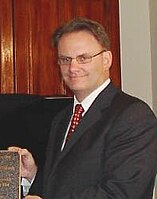
The 2004 Australian federal ballot was held in Australia on 9 October 2004. All 150 seats in the House of Representatives and twoscore seats in the 76-member Senate were up for election. The incumbent Liberal Party of Commonwealth of australia led by Prime number Minister of Commonwealth of australia John Howard and coalition partner the National Party of Australia led by John Anderson defeated the opposition Australian Labor Party led by Marker Latham.
As of 2021, this is the nearly contempo federal ballot in which the leader of the winning political party would consummate a full term of Parliament as Prime number Minister.
Results [edit]
Firm of Representatives results [edit]
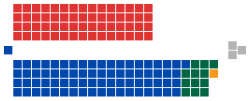
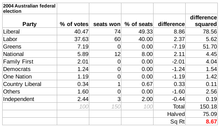
The disproportionality of the lower house in the 2004 ballot was viii.67 co-ordinate to the Gallagher Alphabetize, mainly betwixt the Liberal and Green Parties.

| Party | Votes | % | Swing | Seats | Alter | |||
|---|---|---|---|---|---|---|---|---|
| Liberal–National coalition | v,471,588 | 46.71 | +3.79 | 87 | +5 | |||
| Liberal | 4,741,458 | xl.47 | +3.39 | 74 | +5 | |||
| National | 690,275 | 5.89 | +0.28 | 12 | −1 | |||
| Country Liberal | 39,855 | 0.34 | +0.02 | 1 | 0 | |||
| Labor | four,408,820 | 37.63 | −0.21 | 60 | −4 | |||
| Greens | 841,734 | seven.19 | +2.23 | 0 | −1 | |||
| Family First | 235,315 | ii.01 | +ii.01 | 0 | 0 | |||
| Democrats | 144,832 | 1.24 | –four.17 | 0 | 0 | |||
| One Nation | 139,956 | one.nineteen | −3.15 | 0 | 0 | |||
| Christian Democrats | 72,241 | 0.62 | +0.02 | 0 | 0 | |||
| Citizens Electoral Quango | 42,349 | 0.36 | +0.twenty | 0 | 0 | |||
| Socialist Alliance | 14,155 | 0.12 | +0.12 | 0 | 0 | |||
| New Country | nine,439 | 0.08 | +0.08 | 0 | 0 | |||
| Liberals for Forests | eight,165 | 0.07 | –0.07 | 0 | 0 | |||
| No GST | 7,802 | 0.07 | –0.05 | 0 | 0 | |||
| Ex-Service, Service and Veterans | four,369 | 0.04 | +0.04 | 0 | 0 | |||
| Progressive Labour | 3,775 | 0.03 | –0.01 | 0 | 0 | |||
| Outdoor Recreation | 3,505 | 0.03 | +0.03 | 0 | 0 | |||
| Relieve the ADI Site | iii,490 | 0.03 | –0.02 | 0 | 0 | |||
| Great Australians | 2,824 | 0.02 | +0.02 | 0 | 0 | |||
| Fishing | ii,516 | 0.02 | +0.01 | 0 | 0 | |||
| Lower Excise Fuel and Beer | 2,007 | 0.02 | –0.02 | 0 | 0 | |||
| Democratic Labor | 1,372 | 0.01 | +0.01 | 0 | 0 | |||
| Non-Custodial Parents | i,132 | 0.01 | +0.00 | 0 | 0 | |||
| HEMP | 787 | 0.01 | –0.02 | 0 | 0 | |||
| Nuclear Disarmament | 341 | 0.00 | +0.00 | 0 | 0 | |||
| Aged and Inability Pensioners | 285 | 0.00 | +0.00 | 0 | 0 | |||
| Independents | 292,036 | two.49 | −0.40 | 3 | 0 | |||
| Total | 11,714,835 | 150 | ||||||
| Two-party-preferred vote | ||||||||
| Coalition | Win | 52.74 | +1.79 | 87 | +5 | |||
| Labor | 47.26 | −i.79 | 60 | -5 | ||||
Independents: Peter Andren, Tony Windsor, Bob Katter
Business firm of Representatives preference flows [edit]
- The Nationals had candidates in 9 seats where three-cornered-contests existed, with 84.70% of preferences favouring the Liberal Political party.
- The Greens contested all 150 electorates with preferences strongly favouring Labor (80.86%)
- Family Start contested 109 electorates with preferences favouring the Liberal/National Coalition (66.57%)
- The Democrats contested 125 electorates with preferences slightly favouring Labor (58.91%)
- Ane Nation contested 77 electorates with preferences slightly favouring the Liberal/National Coalition (56.4%)
Seats changing hands [edit]
In the House of Representatives, the Coalition won eight seats from Labor: Bass (Tas), Bonner (Qld), Braddon (Tas), Greenway (NSW), Hasluck (WA), Kingston (SA), Stirling (WA) and Wakefield (SA). Labor won four seats from the Coalition: Adelaide (SA), Hindmarsh (SA), Parramatta (NSW) and Richmond (NSW). The Coalition thus had a net proceeds of four seats. The redistribution had also delivered them McMillan (Vic), formerly held by Christian Zahra of Labor and won by Liberal Russell Broadbent; and Bowman (Qld), formerly held past Labor'due south Con Sciacca and won by Liberal Andrew Laming. Labor, meanwhile, received the new seat of Bonner (Qld) and the redistributed Wakefield (SA), both of which were lost to the Liberal Political party. The Labor Party regained the seat of Cunningham, which had been lost to the Greens in a by-election in 2002.
| Seat | Pre-2004 | Swing | Post-2004 | ||||||
|---|---|---|---|---|---|---|---|---|---|
| Party | Fellow member | Margin | Margin | Fellow member | Party | ||||
| Adelaide, SA | Liberal | Trish Worth | 0.62 | i.95 | 1.33 | Kate Ellis | Labor | ||
| Bass, Tas | Labor | Michelle O'Byrne | two.06 | 4.69 | two.63 | Michael Ferguson | Liberal | ||
| Bonner, Qld | Labor | Hon Con Sciacca* | 1.89 | 2.40 | 0.51 | Ross Vasta | Liberal | ||
| Braddon, Tas | Labor | Sid Sidebottom | v.96 | 7.09 | 1.thirteen | Marking Baker | Liberal | ||
| Cunningham, NSW | Greens | Michael Organ | 2.17 | 12.82 | x.65 | Sharon Bird | Labor | ||
| Greenway, NSW | Labor | Frank Mossfield | three.11 | three.69 | 0.58 | Louise Markus | Liberal | ||
| Hasluck, WA | Labor | Sharryn Jackson | 1.78 | 3.60 | 1.82 | Stuart Henry | Liberal | ||
| Hindmarsh, SA | Liberal | Chris Gallus | 0.96 | one.02 | 0.06 | Steve Georganas | Labor | ||
| Kingston, SA | Labor | David Cox | 1.35 | 1.42 | 0.07 | Kym Richardson | Liberal | ||
| Parramatta, NSW | Liberal | Ross Cameron | ane.15 | 1.92 | 0.77 | Julie Owens | Labor | ||
| Richmond, NSW | National | Hon Larry Anthony | 1.68 | 1.87 | 0.19 | Justine Elliot | Labor | ||
| Stirling, WA | Labor | Jann McFarlane | ane.58 | iii.62 | 2.04 | Michael Keenan | Liberal | ||
| Wakefield, SA | Labor | Martyn Evans* | 1.26 | 1.93 | 0.67 | David Fawcett | Liberal | ||
- *Con Sciacca was in fact the member for the seat of Bowman, which had go Liberal in a redistribution; he instead contested the new seat of Bonner. Martyn Evans was the member for the abolished seat of Bonython; he instead contested the seat of Wakefield.
Senate results [edit]
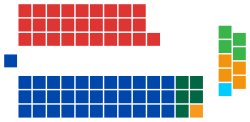
| Political party | Votes | % | Swing | Seats won | Standing senators | Seats held | |
|---|---|---|---|---|---|---|---|
| Australian Labor Party | 4,186,715 | 35.02 | +0.seventy | xvi | 12 | 28 | |
| Liberal/National (Joint Ticket) | three,074,952 | 25.72 | +1.85 | half-dozen | – | ||
| Liberal Political party of Australia | two,109,978 | 17.65 | +i.96 | 13 | x | 33 | |
| Australian Greens | 916,431 | vii.67 | +2.73 | 2 | 2 | 4 | |
| Australian Democrats | 250,373 | ii.09 | −five.16 | 0 | 4 | iv | |
| Family Kickoff Party | 210,567 | 1.76 | * | 1 | – | 1 | |
| One Nation | 206,455 | i.73 | −3.81 | 0 | – | 0 | |
| National Party of Australia | 163,261 | i.37 | −0.55 | 1 | iv | 5 | |
| Christian Democratic Party | 140,674 | 1.18 | +0.06 | 0 | – | 0 | |
| Liberals for Forests | 107,130 | 0.ninety | +0.xv | 0 | – | 0 | |
| Democratic Labor Party | 58,042 | 0.49 | −0.08 | 0 | – | 0 | |
| The Fishing Party | fifty,356 | 0.42 | +0.xviii | 0 | – | 0 | |
| Country Liberal Party | 41,923 | 0.35 | +0.00 | one | – | one | |
| Help Stop Marijuana Prohibition | 41,501 | 0.35 | −0.twenty | 0 | – | 0 | |
| Ex-Service, Service and Veterans Party | 25,277 | 0.21 | * | 0 | – | 0 | |
| Citizens Electoral Quango | 24,663 | 0.21 | +0.14 | 0 | – | 0 | |
| Lower Excise Fuel and Beer Political party | 19,156 | 0.xvi | −0.04 | 0 | – | 0 | |
| Australian Progressive Alliance | 18,856 | 0.sixteen | * | 0 | – | 0 | |
| Progressive Labour Political party | 18,424 | 0.xv | −0.50 | 0 | – | 0 | |
| The Aged and Disability Pensioners Party | 17,401 | 0.15 | * | 0 | – | 0 | |
| Outdoor Recreation Party | thirteen,822 | 0.12 | * | 0 | – | 0 | |
| Socialist Alliance | 13,305 | 0.11 | * | 0 | – | 0 | |
| Not-Custodial Parents Party | 12,207 | 0.10 | +0.06 | 0 | – | 0 | |
| Australians Against Farther Clearing | 11,508 | 0.10 | −0.08 | 0 | – | 0 | |
| New Country Party | 11,040 | 0.09 | * | 0 | – | 0 | |
| No GST Party | 9,713 | 0.08 | −0.35 | 0 | – | 0 | |
| The Corking Australians | 6,984 | 0.06 | * | 0 | – | 0 | |
| Republican Party of Commonwealth of australia | 4,168 | 0.03 | −0.06 | 0 | – | 0 | |
| Save the ADI Site Political party | 3,281 | 0.03 | * | 0 | – | 0 | |
| Hope Party Australia | 2,938 | 0.02 | −0.01 | 0 | – | 0 | |
| Nuclear Disarmament Political party | two,163 | 0.02 | −0.02 | 0 | – | 0 | |
| Other | 180,385 | 1.51 | +1.thirteen | 0 | – | 0 | |
| Total | xi,953,649 | 40 | 36 | 76 | |||

- Julian McGauran later left the Nationals and joined the Liberals.
Overall result [edit]
The Coalition parties won 46.7% of the primary vote, a gain of 3.7% over the 2001 election. The opposition Australian Labor Party polled 37.6%, a loss of 0.ii percentage points. The Australian Greens emerged as the nigh prominent pocket-size party, polling seven.ii%, a gain of ii.2 points. Both the Australian Democrats and 1 Nation had their vote profoundly reduced. After a notional distribution of preferences, the Australian Electoral Commission estimated that the Coalition had polled 52.74% of the two-party-preferred vote, a gain of i.vii points from 2001.
The Liberal Party won 74 seats, the National Party 12 seats and the Country Liberal Party (the Northern Territory branch of the Liberal Political party) one seat, against the Labor opposition's sixty seats. 3 independent members were re-elected. The Coalition also won 39 seats in the 76-member Senate, making the Howard Government the first regime to have a majority in the Senate since 1981. The size of the government'southward win was unexpected: few commentators[ who? ] had predicted that the coalition would really increase its majority in the Firm of Representatives, and almost none had foreseen its gaining a bulk in the Senate.[ citation needed ] Even Howard had described that feat equally "a big ask".[ citation needed ]
The election result was a triumph for Howard, who in December 2004 became Australia's 2nd-longest serving Prime number Minister, and who saw the ballot result equally a vindication of his policies, specially his determination to join in the 2003 invasion of Republic of iraq. The results were a setback for the Labor leader, Mark Latham, and contributed to his resignation in January 2005 after bold the leadership from Simon Crean in 2003.[ citation needed ] The defeat fabricated Labor'south task more difficult: a provisional pendulum for the House of Representatives,[1] showed that Labor would need to win 16 seats to win the post-obit election. However, Kim Beazley said that the accession of Latham to the ALP leadership, in December 2003, had rescued the party from a much heavier defeat.[2] Beazley stated that polling a twelvemonth before the ballot indicated that the ALP would lose "25–30 seats" in the House of Representatives. Instead the party lost a internet iv seats in the House, a swing of 0.21 per centum points. In that location was also a 1.i-betoken swing to the ALP in the Senate. The Coalition gaining control of the Senate was enabled by a plummet in first preferences for the Australian Democrats and One Nation.
Members and Senators defeated in the election include Larry Anthony, the National Party Minister for Children and Youth Affairs, defeated in Richmond, New S Wales; erstwhile Labor minister Con Sciacca, defeated in Bonner, Queensland; Liberal Parliamentary Secretaries Trish Worth (Adelaide, South Australia) and Ross Cameron (Parramatta, New South Wales); and Democrat Senators Aden Ridgeway (the only ethnic fellow member of the approachable Parliament), Brian Greig and John Blood-red. Liberal Senator John Tierney (New South Wales), who was dropped to number 4 on the Coalition Senate ticket, was also defeated.

Celebrity candidates Peter Garrett (Labor, Kingsford Smith, New South Wales) and Malcolm Turnbull (Liberal, Wentworth, New South Wales) hands won their contests. Prominent clergyman Fred Nile failed to win a Senate seat in New Due south Wales. The commencement Muslim candidate to be endorsed by a major political party in Australia, Ed Husic, failed to win the seat of Greenway, New South Wales, for Labor. The quondam One Nation leader, Pauline Hanson, failed in her bid to win a Senate seat in Queensland equally an independent.
Minor parties had mixed results. The Australian Democrats polled their lowest vote since their creation in 1977, and did non retain any of the three Senate seats they were defending. The Australian Greens won their showtime Senate seat in Western Australia and retained the Seat they were defending in Tasmania. They did non achieve a widely expected Senate Seat in Victoria, due to fellow progressive parties, the Australian Labor Party and The Australian Democrats, as well as some micro parties, joining with the conservative parties in a preference deal with far-right evangelist Christian party Family First, which despite a pop vote of just 1.vii% received so many preferences from the unsuccessful Candidates of other parties that it eventually overtook the Greens David Risstrom'south seven.4% vote and claimed that Senate Seat. As predicted, the Greens did not proceeds Senate seats in Queensland or S Commonwealth of australia, partly because of like preference deals by fellow progressive parties, but also because of a traditionally lower vote in these States. Predictably, the Greens lost their commencement and (at the time) merely Lower House seat of Cunningham, which they had gained by style of an electoral anomaly at the 2002 past-ballot in that Seat, which when The Liberal Party did not provide a Candidate, caused singular voting patterns, overwhelmingly amongst voters who would normally have voted for The Liberals and did not want to vote for their traditional nemeses, The Labor Party.
The Australian Progressive Alliance leader, Senator 1000000 Lees, and the One Nation parliamentary leader, Senator Len Harris, lost their seats. I Nation's vote in the Business firm of Representatives collapsed. The Christian Autonomous Party, the Citizens Electoral Council, the Democratic Labor Party, the Progressive Labour Party and the Socialist Alliance all failed to make whatever bear on. The Family Offset Party polled 2% of the vote nationally, and their candidate Steve Fielding won a Senate seat in Victoria.
Issue [edit]
| Parties | Chief votes House | % House | Seats Firm | Votes Senate | % Senate | Seats won Senate | Total seats Senate | |
|---|---|---|---|---|---|---|---|---|
| Liberal Party of Australia | 4,741,458 | 40.5 | 74 | 2,109,978 | 17.7 | 13 | 33 | |
| National Party of Australia | 690,275 | five.nine | 12 | 163,261 | i.4 | 1 | 5 | |
| Liberal/National Party senate ticket (NSW and Vic) | – | – | – | 3,074,952 | 25.7 | half dozen | * | |
| State Liberal Political party | 39,855 | 0.three | 1 | 41,923 | 0.iv | 1 | ane | |
| Australian Labor Party | 4,409,117 | 37.six | 60 | 4,186,715 | 35.0 | 16 | 28 | |
| Australian Greens | 841,734 | seven.2 | – | 916,431 | 7.seven | 2 | 4 | |
| Family First Political party | 235,315 | ii.0 | – | 210,567 | 1.8 | 1 | ane | |
| Australian Democrats | 144,832 | i.2 | – | 250,373 | ii.ane | – | four | |
| One Nation Political party | 139,956 | 1.two | – | 206,455 | ane.7 | – | – | |
| Christian Democratic Party | 72,241 | 0.6 | – | 140,674 | ane.2 | – | – | |
| Other parties | 108,313 | 0.9 | – | 652,320 | 5.5 | – | – | |
| Independents | 288,206 | 2.4 | iii | – | – | – | – | |
| Total (turnout 94.85%) | 11,715,132 | 100.0 | 150 | 11,953,649 | 100.0 | xl | 76 | |
| Informal votes | 639,851 | |||||||
| Total votes | 12,354,983 | |||||||
| Registered voters | 13,021,230 | |||||||
| * Liberal/National senators shown under their respective parties | ||||||||
| Sources: Australian Balloter Commission, Parliament of Commonwealth of australia Parliamentary Handbook | ||||||||
The Liberal and National parties run joint tickets in some states. The figures under "Seats" evidence the number of Senate seats won at this election. These take been added to the number of seats won in 2001 to give the total number of seats in Senate which each party volition hold after one July 2005, when the new Senators take their seats.
The National and Liberal Parties won the fifth and sixth Senate seats in Queensland, thus giving the Coalition 39 seats and outright control of the Senate. Labor won the terminal Senate seats in New South Wales and S Australia, giving it 28 seats. The Greens won the final Senate seats in Western Australia and Tasmania, increasing their Senate seats from 2 to iv.
Pre-ballot issues [edit]
In the wake of the 2002 Bali Bombings and the 2001 World Merchandise Center attacks, the Howard regime along with the Blair and Bush-league governments, initiated gainsay operations in Afghanistan and an alliance for invading Iraq, these issues divided Labor voters[ citation needed ] who were unduly anti-war,[ commendation needed ] flipping those votes from Labor and to the Greens.[ citation needed ] The second outcome was the ongoing and continued worsening of the Millennium Drought continued to eternalize back up for the Nationals water management policies of the Murray-Darling river organization,[ commendation needed ] diverting focus abroad from rural and inner-metropolis customs h2o supplies and focusing on Regional and Farmland water supplies.
The campaign [edit]
The Prime number Minister, John Howard, announced the election at a press conference in Canberra on 29 August, after meeting the Governor-General, Major General Michael Jeffery, at Government House.
Opening shots: "who practice you trust?" [edit]
John Howard told the press conference that the election would be well-nigh trust.[ citation needed ] "Who exercise you trust to proceed the economic system stiff and protect family unit living standards?" he asked "Who do yous trust to keep interest rates low? Who do you trust to lead the fight on Australia's behalf confronting international terrorism?"[ citation needed ]
Howard, who turned 64 in July, declined to answer questions about whether he would serve a full three-yr term if his government was re-elected. "I volition serve every bit long every bit my political party wants me to," he said.[3]
At a press conference in Sydney half an hour later Howard's declaration, Opposition Leader Mark Latham welcomed the election, saying the Howard Government had been in power as well long. He said the main issue would be truth in government. "Nosotros've had too much dishonesty from the Howard Regime", he said. "The ballot is about trust. The Government has been dishonest for too long."[4]
Labor starts ahead in national opinion polls [edit]
The campaign began with Labor leading in all published national opinion polls.[ citation needed ] On 31 August, Newspoll published in The Australian newspaper gave Labor a lead of 52% to 48% nationwide, which would translate into a comfortable win for Labor in terms of seats. About commentators,[ who? ] nonetheless, expected the election to be very close, pointing out that Labor was too ahead in the polls at the comparable point of the 1998 ballot, which Howard won.[ citation needed ] Howard had also consistently out-polled Latham equally preferred Prime Minister by an average of 11.7 per centum points in polls taken this year.[5]
After the first calendar week, the Coalition draws alee [edit]
Afterwards the showtime calendar week of candidature, a Newspoll conducted for News Corporation newspapers indicated that the Coalition held a atomic number 82 on a 2-party-preferred basis of 52% to 48% in the authorities's 12 about marginal held seats.[ commendation needed ] To secure regime in its own right, Labor needed to win twelve more seats than in the 2001 election.[ citation needed ] In the aforementioned poll, John Howard increased his lead over Mark Latham as preferred Prime Minister by four points.[ citation needed ] The Taverner poll conducted for The Sun-Herald paper revealed that younger voters were more likely to support Labor, with 41% of those anile 18 to 24 supporting Labor, compared with 36% who support the Coalition.[ commendation needed ]
A terrorist attack on the Australian embassy in Jakarta marks the second week [edit]
On 9 September, during the 2nd week of campaigning the election was rocked by a terrorist attack on the Australian embassy in Djakarta, Indonesia.[ citation needed ] John Howard expressed his "utter dismay at this event" and dispatched Strange Government minister Alexander Downer to Djakarta to assist in the investigation.[ citation needed ] Marker Latham committed the Labor party's "full support to all efforts by the Australian and Indonesian governments to ensure that happens".[ commendation needed ] The parties reached an agreement that candidature would stop for 10 September out of respect for the victims of this attack and that this would be in addition to the cessation of campaigning already agreed upon for 11 September in remembrance of the terrorist attacks in 2001.
The leaders debate and the worm turns in Latham's favour [edit]
A debate between John Howard and Marking Latham was televised commercial-free on the Nine Network at vii:30pm on Sunday 12 September. In a alter from previous ballot debates, which involved a unmarried moderator, the leaders were questioned by a five-member panel representing each of the major media groups in Australia. There was a representative from commercial boob tube (Laurie Oakes), the ABC (Jim Middleton), News Limited (Malcolm Farr), John Fairfax Holdings (Michelle Grattan) and radio (Neil Mitchell). Later on an opening address, Howard and Latham responded to questions posed past the panel and had the opportunity to make a closing statement. The 9 Network permitted other tv organisations to transmit the feed, but only the ABC chose to.[ citation needed ]
The debate was followed (simply on the 9 Network) past an analysis of the leaders' operation by the "worm". The worm works past analysing the approval or disapproval of a select group of undecided voters to each argument that a leader makes. Throughout the debate, according to the worm, Latham performed strongly and Howard performed poorly.[ citation needed ] A last poll of the focus group found that 67% of the focus group believed that Latham won the fence and that 33% of the focus group believed that Howard won.[ citation needed ] Major media outlets by and large agreed that Latham had won the debate, although they pointed out that with no further debates scheduled and virtually 4 weeks of the campaign remaining, Latham's gain in the momentum from the debate was unlikely to exist decisive.[ citation needed ] Political commentators[ who? ] noted that the 2001 election argue, between Howard and then opposition leader Kim Beazley, gave the same worm results yet Labor still lost that election.[ citation needed ]

At the midpoint, information technology is too close to call [edit]
By the midpoint of the campaign, subsequently Labor had released its policies on revenue enhancement and education, polls showed that the election was still also close to call. The Newspoll in The Australian, showed (21 September) Labor leading with 52.5% of the 2-party-preferred vote. The ACNielsen poll published in The Sydney Morning Herald and The Age showed the Coalition ahead on 52%. The Morgan poll, which has a poor contempo record of predicting federal elections, showed Labor ahead with 53% on the weekend of 18–19 September. A Galaxy Poll in the Melbourne Herald Sun showed the Coalition ahead with 51%, just showed Labor gaining ground.
Despite Latham's potent performance in the debate, most political commentators[ who? ] argued that he had not gained a clear reward over Howard. They pointed to anomalies in Labor's tax policy and the controversy surrounding Labor's policy of reducing government funding to some non-authorities schools as issues which Howard was successfully exploiting.[ citation needed ]
John Howard and John Anderson launched the Coalition election campaign at a joint function in Brisbane on 26 September. Howard's policy spoken communication tin can be read at the Liberal Party website.[6] Anderson's policy speech tin can be read at the National Party website.[7]
Mark Latham's policy oral communication was delivered, also in Brisbane, on 29 September.
Contradictory polls in the 4th week [edit]
During the fourth calendar week of the campaign contradictory polls continued to appear. The ACNielsen poll published in The Sydney Morn Herald and The Age on 25 September showed the Coalition ahead with 54%, which would translate into a large majority for the government. The Newspoll in The Australian on 28 September showed Labor alee with 52%, which would requite Labor a comfortable majority.
Tasmanian forests erupt as the principal outcome during the last calendar week [edit]
In the last days of the campaign the environment policies regarding the logging of Tasmania's erstwhile-growth forests were released past both major parties, simply too late for the Greens to arrange their preference flows on how-to-vote cards in about electorates every bit the bulk were already printed.[ citation needed ] In the game of "cat and mouse" on Tasmanian woods policy betwixt Marker Latham and John Howard, Latham eventually lost out when Dick Adams (Labor member for the Tasmanian seat of Lyons), Tasmanian Labor Premier Paul Lennon and CFMEU's Tasmanian secretarial assistant Scott McLean all attacked Latham's forest policy.[ citation needed ] At a timber workers' rally on the day Labor's forestry policy was appear, Scott McLean asked those gathered to laissez passer a resolution of no confidence in Mr Latham's ability to lead the country.[8] Michael O'Connor, assistant national secretary of the CFMEU said the Coalition's forest policy represented a much better bargain for his members than Labor's policy.[ix] Australian Labor Political party national president Carmen Lawrence later said that "Labor has only itself to blame for the backlash over its forestry policy" and that information technology was a strategic mistake to release the policy and so late in the election entrada. She stated that she was disappointed in criticism from inside the ALP and union movement, and that the party did non leave itself enough time to sell the package.[10]
Treasury and the Department of Finance reported on the validity of Labor's costings of their promises. They claimed to place a unlike flaw to that identified by Liberal Treasurer Costello, but overall Labor was satisfied with the report.[ citation needed ]
The handshake [edit]
On the morning of 8 October, the day before the election, a tv crew filmed Latham and Howard shaking hands as they crossed paths outside an Australian Broadcasting Corporation radio studio in Sydney. The footage showed Latham appearing to draw Howard towards him and tower over his shorter opponent. The incident received wide media coverage and, while Latham claimed to accept been attempting to go revenge for Howard squeezing his wife'south hand too hard at a press function, it was variously reported as being "ambitious", "bullying" and "intimidating" on the role of Latham.[ citation needed ] The Liberal Party campaign director, Brian Loughnane, subsequently said this incident generated more feedback to Liberal headquarters than annihilation else during the six-week entrada, and that information technology "brought together all the doubts and hesitations that people had about Mark Latham".[ citation needed ] Latham disputes the touch of this incident, nevertheless, having described information technology equally a "Tory gee-up: we got close to each other, sure, but otherwise it was a regulation man's handshake. It's silly to say it toll us votes – my numbers spiked in the concluding night of our polling." (Latham Diaries, p. 369) According to Latham'south account of events, Latham came in close to Howard for the handshake to forestall Howard shaking with his arm rather than his wrist.
Final opinion polls are not conclusive [edit]
The final opinion polls continued to be somewhat contradictory, with Newspoll showing a 50–fifty tie and the Fairfax papers reporting 54–46 to the Coalition. About Australian major daily newspaper editorials backed a return of the Howard authorities, with the notable exceptions of The Sydney Morning Herald, which backed neither party, and The Canberra Times, which backed Labor.[11]
Preference deals [edit]
As in all Australian elections, the flow of preferences from minor parties can exist crucial in determining the final outcome. The close of nominations was followed by a period of bargaining among the parties. Howard fabricated a pitch for the preferences of the Australian Greens past appearing to offering concessions on the event of logging in old-growth forests in Tasmania, and the Coalition directed its preferences to the Greens ahead of Labor in the Senate, but the Greens nevertheless decided to allocate preferences to Labor in virtually electorates. In exchange, Labor agreed to direct its preferences in the Senate to the Greens ahead of the Democrats (but critically, not ahead of other minor parties), increasing the chances that the Greens would displace Australian Democrats Senators in New Due south Wales, Queensland and Western Australia.
The Democrats in plough did a preference bargain with the Family unit First Political party, which angered some Democrats supporters who viewed Family unit First's policies as incompatible with the Democrats'.
The effect of preference deals on Senate outcomes [edit]
In Victoria, Family First, the Christian Democrats and the DLP allocated their senate preferences to Labor, to assist ensure the re-ballot of the number three Labor Senate candidate, Jacinta Collins, a Catholic who has conservative views on some social bug such as abortion. In exchange, Labor gave its Senate preferences in Victoria to Family First ahead of the Greens, expecting Family First to exist eliminated before these preferences were distributed. In the effect, however, Labor and Democrat preferences helped Family Showtime's Steve Fielding beat the Green's David Risstrom to win the last Victorian Senate seat[12] and become Family unit Kickoff'southward first Federal parliamentarian. This outcome generated some controversy and highlighted a lack of transparency in preference deals. Family Commencement were elected in Victoria after receiving one.88% of the vote, even though the Greens had the largest minor party share of the vote with 8.8%. In Australia, 95% of voters vote "higher up the line" in the Senate.[13] Many "above the line" voters do non admission preference allocation listings, although they are bachelor in polling booths and on the AEC website, so they are therefore unaware of where their vote may go. The end result was ane Family Get-go, three Liberal and two Labor Senators elected in Victoria.
In Tasmania, Family Showtime and the Democrats also directed their Senate preferences to Labor, apparently to preclude the possibility of the Liberals winning a majority in the Senate and thus reducing the influence of the minor parties. The Australian Greens' Christine Milne appeared at gamble of losing her Senate seat to a Family First candidate before long after ballot night, despite about obtaining the total required quota of primary votes. However, strong performance on postal and prepoll votes improved Milne's position. It was only the high incidence of "below the line" voting in Tasmania that negated the result of the preference swap deal between Labor and Family First.[fourteen] The end result was one Dark-green, three Liberal and 2 Labor Senators elected in Tasmania.
In New South Wales, Democrat preferences flowing to Labor rather than the Greens were instrumental in Labor'southward winning of the last Senate seat. Had Democrat preferences flown to the Greens rather than Liberals for Forests and the Christian Democrats, then the last vacancy would have been won by the Greens' John Kaye. The scale of Glenn Druery's (of the Liberals for Forests party) preference deals was revealed past the big number of ticket votes distributed when he was eliminated from the count. He gained preferences from a wide range of modest parties such as the Ex-Service Service and Veterans Party, the Outdoor Recreation Political party, and the Non-Custodial Parents Party. Liberals for Forests also gained the preferences of ii leftish parties – the Progressive Labour Party and the HEMP Political party. When Druery was eventually excluded, these preferences flowed to the Greens, simply the Greens would rather have received the preferences earlier in the count. In the end, three Liberal/National Senators and three Labor Senators were elected in New South Wales.[15]
In Western Commonwealth of australia, the Greens' Rachel Siewert was elected to the final vacancy afterward the concluding Labor candidate was excluded. This was a gain for the Greens at the expense of the Democrats Brian Greig. While the Democrats had washed a preference swap with Family First, the bargain in Western Australia did non include the Christian Democrats. As a result, when the Australian Democrats were excluded from the count, their preferences flowed to the Greens, putting them on runway for the final vacancy.[16] The terminate result was 1 Light-green, three Liberal and two Labor Senators elected in Western Australia.
In South Australia, the Australian Democrats negotiated a crucial preference swap with Family Commencement that prevented the Greens winning the final vacancy. If the Democrats had polled better, they would accept collected Family Commencement and Liberal preferences and won the final vacancy. Former Democrat Leader Million Lees also contested the Senate in Due south Commonwealth of australia, just was eliminated late in the count. However, Lees did accept some impact on the consequence, as there were big numbers of beneath the line preferences for both the Progressive Brotherhood (also every bit One Nation) which were widely spread rather than flowing to the Democrats. When the Democrats were excluded, preferences flowed to Family First which prevented the Greens' Brian Noone passing the third Labor candidate. This resulted in a seat that could otherwise have been won by the Greens instead beingness won by Labor on Green preferences. The period of One Nation preferences to Labor fabricated it impossible for either Family unit First or the Liberal Party to win the terminal vacancy. Labor's Dana Wortley was elected to the final vacancy.[17] The end upshot in S Australia was split iii Liberal, 3 Labor.
In Queensland, Pauline Hanson attracted 38,000 beneath the line votes and pulled away from I Nation. Preferences from the Angling Party kept the National Party's Barnaby Joyce ahead of Family unit Start and Pauline Hanson. Joyce then unexpectedly won the fifth vacancy alee of the Liberal Political party. The sixth and terminal vacancy was then won by Liberal Russell Trood.[18] The last outcome was ane National, 3 Liberals and 2 Labor.
The election of both Barnaby Joyce and Russell Trood to the Senate in Queensland resulted in the Coalition gaining control of the Senate and was confirmed past the National Party'southward Senate Leader Ron Boswell'south in a televised phone phone call to Prime Minister John Howard.[nineteen] This outcome was not widely predicted prior to the election.
The outcome of preference deals on House of Representatives and national outcomes [edit]
Despite constant media attention on preference deals, and a widely held belief that the two party preferred result for the election would be close, the Newspoll figures during the 3 months prior to the ballot showed trivial alteration in the starting time preference margin betwixt the parties, nor was in that location whatsoever evidence of whatever voter volatility. The figures suggested, then, that as the Coalition'due south first preference vote was healthy, the virtually probable result was a Government victory. This was built-in out in the election results when the Liberal first preference vote of 40.five per cent was 3.4 percentage points higher than in 2001, while Labor'due south first-preference vote of 37.6 per cent was its everyman since the elections of 1931 and 1934.[20] Preference flows from modest parties are much more than likely to affect an election outcome when the two major parties are close. The collapse of Labor's primary vote therefore negated this event, even though 61 out of 150 House of Representatives seats were decided on preferences.[21]
The national consequence of minor party preference distributions (in order of number primary votes received) is summarised in the following table:[22]
| Minor party | Total votes | % to Liberal/National Coalition | % to Labor |
|---|---|---|---|
| Christian Democratic Party | 72,241 | 74.63 | 25.37 |
| Citizens Electoral Quango | 42,349 | 47.83 | 52.17 |
| Socialist Alliance | 14,155 | 25.55 | 74.45 |
| New Land Party | nine,439 | 59.xvi | 40.84 |
| liberals for forests | eight,165 | 60.18 | 39.82 |
| No GST | vii,802 | 38.11 | 61.89 |
| Ex-Service, Service and Veterans Party | 4,369 | 52.69 | 47.31 |
| Progressive Labour Party | 3,775 | 19.36 | fourscore.64 |
| Outdoor Recreation Party | 3,505 | 44.37 | 55.63 |
| Save the ADI Site Party | 3,490 | 33.12 | 66.88 |
| The Smashing Australians | ii,824 | 61.47 | 38.53 |
| The Fishing Party | 2,516 | 45.15 | 54.85 |
| Lower Excise Fuel and Beer Party | 2,007 | 52.96 | 47.04 |
| Autonomous Labor Political party | one,372 | 58.53 | 41.47 |
| Non-Custodial Parents Party | 1,132 | 26.86 | 73.fourteen |
| HEMP | 787 | 41.93 | 58.07 |
| Nuclear Disarmament Political party | 341 | 20.82 | 79.eighteen |
| Anile and Disability Pensioners Party | 285 | 45.96 | 54.04 |
Party leaders [edit]
- John Howard had been an MP since 1974, leader of the Liberal Party since 1995 (he was previously leader from 1985 to 1989), and Prime Minister since March 1996. He turned 65 in July 2004, and is more than than twenty years older than Mark Latham. Howard is by far the almost experienced politician in Australian federal politics and is considered a master of political strategy, a reputation which was enhanced during the 2004 campaign. Although nigh commentators agreed that he did non perform well in the debate with Latham, his dogged campaigning on interest rates, economic certainty and national security was constructive in persuading voters in marginal seats to stick with the Coalition.
- John Anderson had been an MP since 1988 and leader of the National Political party and Deputy Prime number Minister since 1999. Although talented and personable, he was unable to stem the long-term turn down in the Nationals' rural electoral base. During 2003 he considered retiring from Parliament at this election, but was persuaded non to. Despite his personal continuing, the Nationals lost another seat (Richmond) and struggled to win a Senate spot in Queensland. Anderson stepped down equally leader in July 2005.
- Mark Latham had been an MP since 1994 and was elected leader of the Australian Labor Party in December 2003. Latham initially fabricated a skilful impression, but a series of controversies during 2004 caused much criticism of his declared inconsistency and volatility. His campaign was aggressive and colourful, with a serial of assuming policy announcements belatedly in the entrada. This galvanised Labor's base of operations only many commentators felt that Latham's policies and personality alienated middle-course voters. In retrospect Labor'southward forests policy was a major miscalculation, costing two seats in Tasmania. Latham also failed to effectively counter Howard's campaign on interest rates. Latham resigned for health reasons in Jan 2005 from both his position equally Leader of the Opposition and every bit Member for Werriwa in the Business firm of Representatives.
- Andrew Bartlett had been a Senator since 1997 and leader of the Australian Democrats since 2002 when Natasha Stott Despoja stood down from the position. The efforts to revive the Democrats' public back up were unsuccessful. A widely publicised incident in December 2003 where he confronted Liberal Senator Jeannie Ferris while exiting the Senate sleeping accommodation did non help these efforts. The Democrats' ballot result in 2004 was the worst in the party'south history to that time. He chose not to recontest the leadership later that election, and Senator Lyn Allison took on the leadership role.
- Bob Brown had been a Senator and the informal leader of the Australian Greens since 1996. By opposing Australia's participation in the Iraq War he established himself as the virtually prominent effigy of the Australian left. Merely media predictions that the Greens would greatly increase their vote and win a Senate seat in every state, or even win Firm seats, were not realised. Although the Greens took some votes from the Democrats, many flowed to other parties and the predicted big inroads into Labor'south base vote did not occur.
Disclosure [edit]
Dates for financial disclosure for the 2004 Federal election were specified past the Australian Balloter Commission. Broadcasters and publishers had to lodge their returns by 6 December, while candidates and Senate groups needed to lodge by 24 January 2005. This information was made bachelor for public scrutiny on 28 March 2005.
See too [edit]
- Results of the Australian legislative ballot, 2004
- Candidates of the 2004 Australian federal election
- Members of the Australian House of Representatives, 2004–2007
- Members of the Australian Senate, 2005–2008
References [edit]
- ^ "Democracy OF AUSTRALIA FEDERAL Ballot OF 9 OCTOBER 2004 Firm OF REPRESENTATIVES DIVISIONS IN Club OF Strength FOR ALP". Archived from the original on 13 February 2006. Retrieved 7 July 2021.
- ^ "Risky strategy ends in disaster for Labor – Election 2004". smh.com.au. 10 October 2004. Retrieved 24 May 2010.
- ^ See total report Archived vii January 2006 at the Wayback Machine and transcript of Howard's printing conference.
- ^ See full report of Latham's press conference. Archived 20 Baronial 2008 at the Wayback Auto
- ^ "Newspoll archive since 1987". Polling.newspoll.com.au.tmp.ballast.cyberspace.au. Archived from the original on 3 March 2016. Retrieved 30 July 2016.
- ^ [1] Archived 29 September 2004 at the Wayback Machine
- ^ Anderson, John (26 September 2004). "SPEECH TO COALITION Campaign LAUNCH" (PDF). Archived (PDF) from the original on 17 March 2005. Retrieved 7 July 2021.
- ^ "Union official may be dumped in election fallout. 14/x/2004. ABC News Online". abc.cyberspace.au. 14 October 2004. Archived from the original on 15 February 2009. Retrieved 24 May 2010.
- ^ "Howard trades trees for jobs – Election 2004". theage.com.au. vii October 2004. Retrieved 24 May 2010.
- ^ "Forestry policy too rushed, Labor president says. 12/10/2004. ABC News Online". Abc.net.au. 12 October 2004. Archived from the original on 23 November 2007. Retrieved 24 May 2010.
- ^ "Article | ninemsn news". News.ninemsn.com.au. 13 September 2009. Archived from the original on 21 October 2007. Retrieved 24 May 2010.
- ^ "How party preferences picked Family unit First – Ballot 2004". theage.com.au. 11 October 2004. Retrieved 24 May 2010.
- ^ "Federal Election 2004. How Senate Voting Works. Antony Green's Election Guide. Australian Broadcasting Corporation". ABC. 22 September 2004. Archived from the original on 11 May 2010. Retrieved 24 May 2010.
- ^ "In a higher place or below the line? Managing preference votes – On Line Stance – xx/4/2005". On Line Opinion. thirteen April 2005. Retrieved 24 May 2010.
- ^ "2004 Federal Ballot. Senate – NSW Results. Australian Broadcasting Corporation". ABC. Archived from the original on xx April 2010. Retrieved 24 May 2010.
- ^ "2004 Federal Election. Senate – WA Results. Australian Dissemination Corporation". ABC. Retrieved 24 May 2010.
- ^ "2004 Federal Election. Senate – SA Results. Australian Broadcasting Corporation". ABC. Archived from the original on twenty Apr 2010. Retrieved 24 May 2010.
- ^ "2004 Federal Election. Senate – QLD Results. Australian Broadcasting Corporation". ABC. Archived from the original on 21 Apr 2010. Retrieved 24 May 2010.
- ^ "Lateline – 28/10/2004: Coalition gains Senate control". Abc.cyberspace.au. 28 October 2004. Archived from the original on 20 October 2007. Retrieved 24 May 2010.
- ^ "Republic Election 2004". Aph.gov.au. Archived from the original on 23 October 2009. Retrieved 24 May 2010.
- ^ "Seats Decided on Preferences". Results.aec.gov.au. 9 November 2005. Retrieved 24 May 2010.
- ^ "Preference flows at the 2004 House of Representatives election". Aph.gov.au. Archived from the original on 9 May 2010. Retrieved 24 May 2010.
Bibliography [edit]
- Academy of WA election results in Commonwealth of australia since 1890
- AEC 2PP vote
- AustralianPolitics.com election details
- Australian Idol beats election argue (13 September 2004). The Age.
- Family First weighs in on key issues (xi October 2004). The Sydney Forenoon Herald.
- ALP hurt past forests burn (11 Oct 2004). The Historic period
- Howard trades trees for jobs (vii October 2004). The Age
- Union official may exist dumped in ballot fallout (xiv Oct 2004). ABC News Online.
- Forestry policy as well rushed, Labor president says (12 October 2004). ABC News Online.
- How political party preferences picked Family First – Election 2004, (11 October 2004). The Age.
External links [edit]
- Balloter sites
- The ABC's 2004 Federal Ballot Site
- ABC News Election Summary, past elections analyst Antony Dark-green
- "The Mackerras Pendulum" Malcolm Mackerras
- Adam Carr's Ballot Archive
- Australian Electoral Commission website
- All the candidates and Senate preferences
- AEC Virtual Tally Room
- Party sites
- Australian Labor Party website
- Liberal Party website
- The Nationals website
- Australian Democrats website
- Family Kickoff Party website
- Australian Greens website
- Socialist Brotherhood website
- Citizens Electoral Council website
- State Liberal Party website
Source: https://en.wikipedia.org/wiki/2004_Australian_federal_election
0 Response to "A Vindication of the Conduct of the House of Representatives"
Enviar um comentário