California Races for U.s House of Representatives
Race and Ethnicity in the U.Southward.
The U.Due south. has a diverse order, and its history is marked by attempts to concentrate power, wealth, and privilege into the hands of whites.
Learning Objectives
Describe the history and electric current situation of at least iii minorities in the U.S.
Cardinal Takeaways
Key Points
- The emphasis on racial distinctions oft results in the failure to acknowledge the ethnic and national diversity that diverse racial groups encompass.
- The negative effects of unequal race relations can be seen to this solar day, admitting to dissimilar degrees, amongst all non-European American groups.
- A model minority is a stereotype of a minority grouping that is considered to have achieved educational, professional, and socioeconomic success without threatening the status quo.
Primal Terms
- Multi-Racial: When a person's heritage comes from a variety of different races.
- Model Minority: A minority group that is seen as reaching significant educational, professional, and socioeconomic levels without challenging the existing establishment.
The U.s.a. is a very diverse, multi-racial and multi-ethnic country; people from effectually the globe take been immigrating to the U.s.a. for several hundred years. While the commencement wave of immigrants came from Western Europe, the bulk of people entering North America were from Northern Europe, then Eastern Europe, followed by Latin America and Asia. At that place was too the forced immigration of African slaves. Native Americans, who did not immigrate but rather inhabited the land prior to immigration, experienced deportation equally a result. Virtually of these groups also suffered a period of disenfranchisement and prejudice as they went through the procedure of assimilation.
Since its early on history, Native Americans, African Americans, and European Americans were considered every bit different races in the United States. The differences attributed to each group, withal, especially the differences used to designate European Americans as the superior race, had little to practice with biology. Instead, these racial designations were a means to concentrate power, wealth, state, and privilege in the hands of the European Americans. Moreover, the emphasis on racial distinctions often led to the lack of acknowledgement or over-simplification of the great ethnic diversity of the country'southward population. For example, the racial category of "white" or European American fails to reflect that members of this grouping hail from very unlike countries. Similarly, the racial category of "black" does not distinguish people from the Caribbean from those who were brought to North America from diverse parts of Africa.
Today, the U.S. continues to run into a significant influx of immigrants from all over the world. Race relations in the U.South. remain problematic, marked by discrimination, persecution, violence, and an ongoing struggle for power and equality.
Native Americans
The savage confrontation between the European colonists and the Native Americans, which resulted in the decimation of the latter's population, is well known as an historical tragedy. Even later the establishment of the United States regime, discrimination against Native Americans was codified and formalized in a series of laws intended to subjugate them and continue them from gaining any ability. The eradication of Native American civilization continued until the 1960s, when Native Americans were able to participate in, and benefit from, the ceremonious rights movement. Native Americans still endure the furnishings of centuries of degradation. Long-term poverty, inadequate instruction, cultural dislocation, and high rates of unemployment contribute to Native American populations falling to the bottom of the economic spectrum.
African Americans
African Americans arrived in North America nether duress equally slaves, and there is no starker illustration of the dominant- subordinate group relationship than that of slavery. Slaves were stripped of all their rights and privileges, and were at the absolute mercy of their owners. For African Americans, the civil rights movement was an indication that a subordinate grouping would no longer willingly submit to domination. The major blow to America'due south formally institutionalized racism was the Civil Rights Human activity of 1964. This Human action, which is all the same followed today, banned discrimination based on race, color, organized religion, sex, or national origin. Some sociologists, however, would debate that institutionalized racism persists, especially since African Americans notwithstanding fair poorly in terms of employment, insurance coverage, and incarceration, as well as in the areas of economics, health, and education.
Asian Americans
Asian Americans come from a diversity of cultures, including Chinese, Japanese, and Vietnamese. They, as well, have been subjected to racial prejudice. The Chinese Exclusion Act of 1882, for case, which was motivated past white workers blaming Chinese migrants for taking their jobs, resulted in the precipitous end of Chinese immigration and the segregation of Chinese already in America; this segregation resulted in the Chinatowns plant in large cities. Notwithstanding, despite a hard history, Asian Americans have earned the positive stereotype of the model minority. The model minority stereotype is practical to a minority grouping that is seen as reaching meaning educational, professional person, and socioeconomic levels without challenging the existing institution.
Hispanic Americans
Hispanic Americans come from a broad range of backgrounds and nationalities. Mexican Americans form the largest Hispanic subgroup, and also the oldest. Mexican Americans, peculiarly those who are here illegally, are at the middle of a national debate almost immigration. Mexican immigrants experience relatively low rates of economic and civil absorption, which is virtually likely compounded by the fact that many of them are illegally in the country. By dissimilarity, Cuban Americans are often seen as a model minority group inside the larger Hispanic group. As with Asian Americans, yet, being a model minority can mask the issue of powerlessness that these minority groups confront in U.Due south. society.
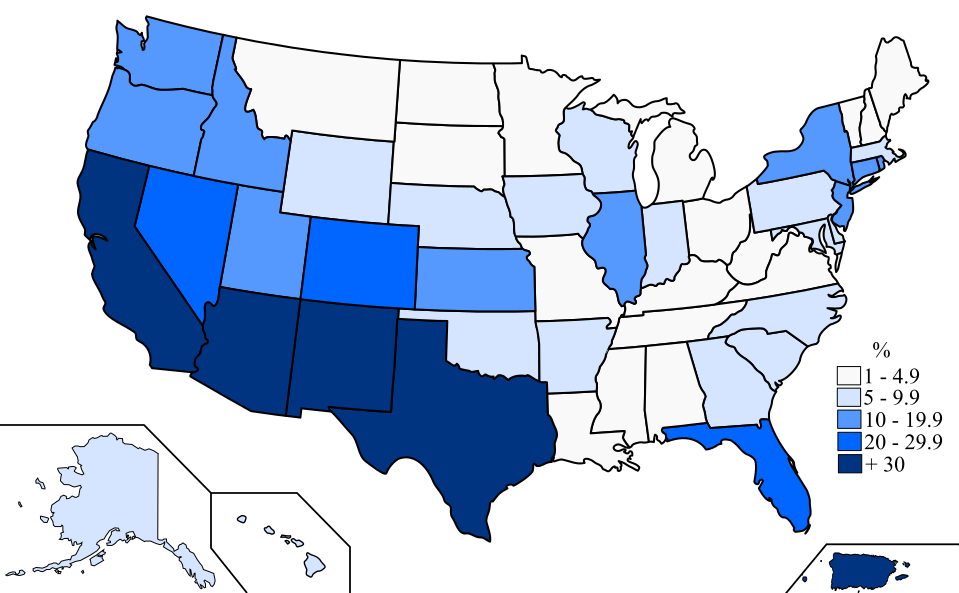
Hispanic Population Distribution in the US: This map shows information gathered in the 2010 U.s.a. Demography of Spanish-speaking populations around the US.
Racial Groups
The U.s.a. is a diverse state, racially and ethnically.
Learning Objectives
Explain what definitions of race are deployed past the U.South. census
Fundamental Takeaways
Fundamental Points
- The United States Census Agency besides classifies Americans as " Hispanic or Latino" and "Not Hispanic or Latino. " Hispanic and Latino Americans are a racially diverse ethnicity that composes the largest minority group in the nation.
- The ane drop rule, a historical colloquial term, stated that any one considered to have even a drop of black blood was to exist classified equally existence black. This was an effort to restore white supremacy during the post Ceremonious State of war Reconstruction era.
- The Claret Breakthrough, or Indian Blood, Laws refers to legislation in the The states to establish a person's membership in Native American tribes or nations.
Fundamental Terms
- I Drib Rule: A historical vernacular term in the United States for the social classification as black of individuals with whatsoever African ancestry; meaning any person with "one drop of black claret" was considered black.
- Other Pacific Islander: A Us Census category referring to individuals from the Pacific Islands but non Hawaii.
- ethnicity: The identity of a group of people having mutual racial, national, religious, or cultural origins.
The United states of america is a various land, racially and ethnically. Half-dozen races are officially recognized: white, American Indian and Alaska Native, Asian, black or African American, Native Hawaiian and other Pacific Islander, and people of two or more races. A race called, "Some other race," is too used in the census and other surveys but is non official.
The United States Census Bureau too classifies Americans as "Hispanic or Latino" and "Non Hispanic or Latino," which identifies Hispanic and Latino Americans as a racially various ethnicity that composes the largest minority grouping in the nation.
History
The immigrants to the New Earth of the Americas came largely from ethnically diverse regions of the European Old Globe. In the Americas, the immigrant populations began to mix among themselves and with the indigenous inhabitants of the continent, as well as the enslaved Africans.
From the beginning of U.South. history, Native Americans, African Americans, and European Americans were classified as belonging to different races. For nearly three centuries, the criteria for membership in these groups were similar, comprising a person'due south appearance, their fraction of known non-European ancestry and their social circle. This changed in the late nineteenth century.
Throughout the post-Civil War Reconstruction era, in an effort to restore white supremacy in the South later on the emancipation of slaves, the ruling white majority began to classify anyone considered to accept "one drop" of "black blood," or any known African beginnings, to be "black." In almost southern states, this definition was not put into law until the twentieth century. Many local governments established racial segregation of facilities during what came to exist known every bit the Jim Crow era, which began in the late 1800s.
In the twentieth century, efforts to sort the increasingly mixed population of the United States into discrete categories generated many difficulties for the U.Southward. regime (Spickard, 1992). By the standards used in past censuses, many millions of mixed-race children born in the United States have been classified equally of a dissimilar race than one of their biological parents. Efforts to track mixing betwixt groups led to a proliferation of categories (such as "mulatto" and "octoroon") and so-called "blood quantum" distinctions, which refers to the degree of ancestry for an individual of a specific racial or ethnic group (e.g., saying someone is "1/4 Omaha tribe").
These various distinctions became increasingly untethered from self-reported beginnings. Further complicating this fact is that a person's racial identity can modify over fourth dimension, and cocky-ascribed race can differ from assigned race (Kressin et al., 2003).
Electric current Official Definitions of Race and Ethnicity
Aside from their varied social, culture, and political connotations, the thought of racial groups accept been used in U.S. censuses as self-identification data items in which residents choose the race or, starting with the 2000 US Demography, races with which they well-nigh closely identify. Respondents as well indicate whether or not they are of Hispanic or Latino origin, which the census considers separately from race. While many see race and ethnicity as the same thing, ethnicity by and large refers to a group of people whose members place with each other through a common heritage and civilisation, equally opposed to the implication of shared biological traits associated with the term "race."

The American Public by Ancestry, 2000: Specially in the southwest United states of america, people of Latino origin make up a pregnant proportion of United states residents.
These categories, therefore, represent a social-political construct for the race or races that respondents consider themselves to be and "by and large reverberate a social definition of race recognized in this state. " The concept of race, as outlined for the U.Due south. Demography, has been described equally not "scientific or anthropological" and takes into account "social and cultural characteristics as well as ancestry," using "appropriate scientific methodologies" that are not "primarily biological or genetic in reference. " The race categories include both racial and national-origin groups.
Ethnic Groups
An ethnic group is a group of people who share a common heritage, civilization, and/or language; in the U.S., ethnicity oft refers to race.
Learning Objectives
Explain why ethnic and racial categories tend to overlap in the U.S.
Fundamental Takeaways
Key Points
- In the U.s. of America, the term "ethnic" carries a different significant from how information technology is usually used in some other countries, due to the historical and ongoing significance of racial distinctions that categorize together what might otherwise accept been viewed every bit ethnic groups.
- Ethnicity in U.Southward. therefore normally refers to collectives of related groups, having more to practise with physical appearance, specifically peel colour, rather than political boundaries.
- The formal and breezy inscription of racialized groupings into police force and social stratification schemes has bestowed upon race a fundamental social identification role in the Us.
Fundamental Terms
- social stratification: The hierarchical arrangement of social classes, or castes, within a society.
- ethnic grouping: A group of people who identify with ane another, specially on the basis of racial, cultural, or religious grounds.
An ethnic group is a group of people who place with each other through a mutual heritage, which generally consists of a mutual culture and shared linguistic communication or dialect. The group's ethos or ideology may besides stress common ancestry, faith, or race.
In the Usa of America, the term "ethnic" carries a dissimilar meaning from how information technology is commonly used in some other countries. This is due to the historical and ongoing significance of racial distinctions that categorize together what might otherwise have been viewed as ethnic groups. For instance, diverse ethnic, "national," or linguistic groups from Africa, Asia and the Pacific Islands, Latin America, and Ethnic America have long been combined together every bit racial minority groups (currently designated as African American, Asian, Latino and Native American or American Indian, respectively).
While a sense of ethnic identity may coexist with racial identity (Chinese Americans amid Asian or Irish gaelic American among European or White, for instance), the long history of the Usa equally a settler, conquistador, and slave club, and the formal and breezy inscription of racialized groupings into law and social stratification schemes has bestowed upon race a primal social identification office in the United States.
Examples of Overlapping Racial and Indigenous Categories in the U.S.
Ethnicity in U.South. therefore ordinarily refers to collectives of related groups, having more to do with physical appearance, specifically skin color, rather than political boundaries. The give-and-take "nationality" is more normally used for this purpose (e.1000. Italian, Mexican, French, Russian, Japanese). Nearly prominently in the U.S., Latin American descended populations are grouped in a " Hispanic " or "Latino" ethnicity. The many previously designated "Oriental" ethnic groups are at present classified as the "Asian" racial group for the demography.
The terms "Black" and "African American," while different, are both used as ethnic categories in the U.Southward. In the late 1980s, the term "African American" came into prominence as the most appropriate and politically correct race designation. While it was intended every bit a shift abroad from the racial injustices of America'due south past often associated with the historical views of the "Blackness" race, it largely became a simple replacement for the terms Black, Colored, Negro and similar terms, referring to whatever individual of dark skin color regardless of geographical descent.
The term Caucasian by and large describes some or all people whose ancestry tin be traced to Europe, the Heart Due east, the Horn of Africa, Northward Africa, Central Asia, and South asia. This includes European-colonized countries in the Americas, Australasia, and S Africa, among others. All the aforementioned are categorized as part of the "White" racial group, as per U.Due south. Demography categorization. This category has been divide into 2 groups: Hispanics and not-Hispanics (e.g. White not-Hispanic and White Hispanic. )
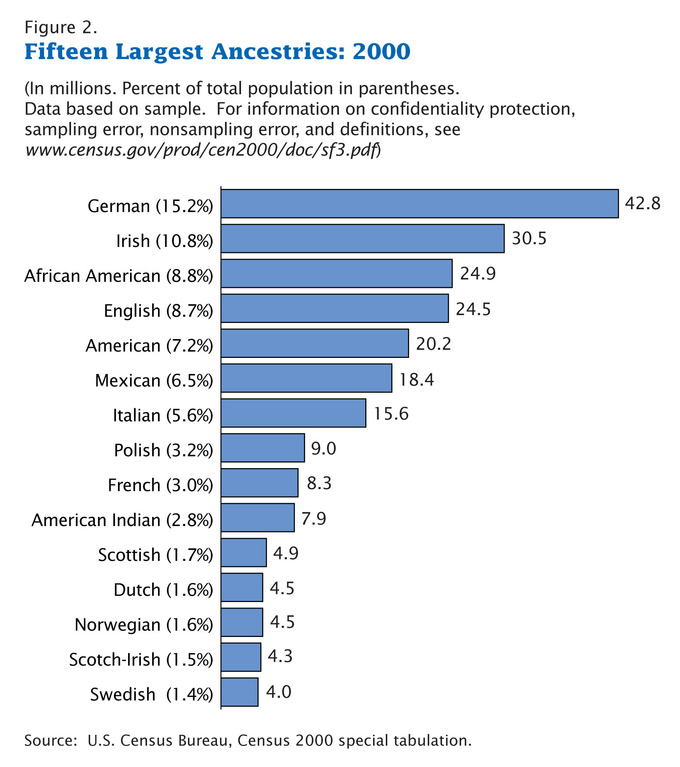
Xv Largest Ancestries in the 2000 Census: Elevation ancestries recorded in 2000.
Clearing and Illegal Immigration
Clearing is the act of foreigners passing or coming into a country for the purpose of permanent residence.
Learning Objectives
Discuss the history and condition of immigration (both legal and illegal) and the workforce in the U.s.a.
Key Takeaways
Key Points
- Immigration to the United States has been a major source of population growth and cultural modify. Different historical periods accept brought distinct national groups, races and ethnicities to the United states of america.
- In recent years, immigration has increased essentially.
- American attitudes toward immigration are markedly ambivalent. In full general, Americans have more than positive attitudes toward groups that have been visible for a century or more, and much more negative attitude toward recent arrivals.
- An illegal immigrant in the The states is an alien (non-denizen) who has entered the United States without regime permission and in violation of United States Nationality Constabulary, or stayed across the termination date of a visa, also in violation of the law.
Key Terms
- clearing: The human activity of immigrating; the passing or coming into a country for the purpose of permanent residence.
- illegal immigration: When a person enters the United States without governmental permission and in violation of the United states of america Nationality Law, or stayed across the termination date of a visa, as well in violation of the police force.
Immigration is the act of foreigners passing or coming into a country for the purpose of permanent residence. Immigration occurs for many reasons, including economic, political, family unit re-unification, natural disasters, or poverty. Many immigrants came to America to escape religious persecution or dire economical conditions. About hoped coming to America would provide freedom and opportunity.
History
Immigration to the United States has been a major source of population growth and cultural change. Different historical periods have brought distinct national groups, races and ethnicities to the United States. During the 17th century, approximately 175,000 Englishmen migrated to Colonial America. Over half of all European immigrants to Colonial America during the 17thursday and 18th centuries arrived as indentured servants. The mid-nineteenth century saw mainly an influx from northern Europe; the early twentieth-century mainly from Southern and Eastern Europe; post-1965 by and large from Latin America and Asia.
Gimmicky Clearing
In recent years, clearing has increased essentially. In 1965, indigenous quotas were removed; these quotas had restricted the number of immigrants allowed from different parts of the world. Immigration doubled between 1965 and 1970, and again between 1970 and 1990. Between 2000 and 2005, nearly 8 million immigrants entered the Us, more than than in any other five-year flow in the nation's history. In 2006, the United states of america accepted more legal immigrants every bit permanent residents than all other countries in the world combined.
Recent Immigration Demographics
Until the 1930s almost legal immigrants were male. By the 1990s, women accounted for merely over half of all legal immigrants. Gimmicky immigrants tend to be younger than the native population of the United States, with people between the ages of 15 and 34 substantially over-represented Immigrants are also more than likely to be married and less likely to be divorced than native-built-in Americans of the aforementioned historic period.
Immigrants come from all over the world, but a significant number come from Latin America. In 1900, when the U.S. population was 76 million, at that place were an estimated 500,000 Hispanics. The Demography Bureau projects that by 2050, i-quarter of the population will be of Hispanic descent. This demographic shift is largely fueled past immigration from Latin America.
Immigrants are probable to move to and live in areas populated past people with similar backgrounds. This phenomenon has held true throughout the history of immigration to the U.s..
Public Opinion Toward Immigrants
American attitudes toward immigration are markedly ambivalent. American history is rife with examples of anti-immigrant opinion. Benjamin Franklin opposed German clearing, warning Germans would not assimilate. In the 1850s, the nativist Know Nothing movement opposed Irish gaelic immigration, promulgating fears that the country was beingness overwhelmed past Irish Cosmic immigrants.
In general, Americans have more positive attitudes toward groups that have been visible for a century or more, and much more negative attitude toward recent arrivals.Co-ordinate to a 1982 national poll by the Roper Center at the University of Connecticut, "Past high margins, Americans are telling pollsters it was a very practiced affair that Poles, Italians, and Jews emigrated to America. Again, it'south the newcomers who are viewed with suspicion. This time, it'southward the Mexicans, the Filipinos, and the people from the Caribbean who brand Americans nervous. "
One of the most important factors regarding public opinion about immigration is the level of unemployment; anti-immigrant sentiment is highest where unemployment is highest, and vice versa. In fact, in the Usa, only 0.16 percent of the workforce are legal immigrants.
Illegal Immigration to the U.s.
An illegal immigrant in the U.s.a. is an alien (not-citizen) who has entered the Usa without authorities permission and in violation of United States Nationality Law, or stayed beyond the termination date of a visa, also in violation of the law. Illegal immigrants continue to outpace the number of legal immigrants—a trend that's held steady since the 1990s. The illegal immigrant population is estimated to exist between 7 and 20 million. More than 50% of illegal immigrants are from Mexico.
While the bulk of illegal immigrants continue to concentrate in places with existing large Hispanic communities, illegal immigrants are increasingly settling throughout the rest of the land. A pct of illegal immigrants do non remain indefinitely but practice return to their country of origin; they are oft referred to as "sojourners", for "they come up to the United States for several years but somewhen return to their home country. "
The continuing do of hiring unauthorized workers has been referred to as the magnet for illegal immigration. Every bit a pregnant percentage of employers are willing to rent illegal immigrants for college pay than they would typically receive in their sometime country, illegal immigrants have prime number motivation to cross borders. But migration is expensive, and unsafe for those who enter illegally. Participants in debates on immigration in the early twenty-first century take chosen for increasing enforcement of existing laws governing illegal immigration to the United States, building a bulwark along some or all of the 2,000-mile (3,200 km) U.S.-United mexican states border, or creating a new guest worker program.
Affirmative Action
Affirmative activity refers refers to policies that accept factors such equally race, gender, sexual orientation, and religion into consideration.
Learning Objectives
Discuss arguments for and confronting affirmative action
Key Takeaways
Key Points
- Affirmative activity measures are intended to prevent discrimination confronting employees or applicants for employment, on the ground of "color, religion, sex, or national origin".
- The controversy surrounding affirmative action's effectiveness is often based on the thought of class inequality.
- Other opponents of affirmative action telephone call it contrary bigotry, proverb affirmative activeness requires the very discrimination it is seeking to eliminate.
Key Terms
- affirmative action: A policy or program providing advantages for people of a minority group who are seen to have traditionally been discriminated confronting, with the aim of creating a more egalitarian society through preferential access to education, employment, health care, social welfare, etc.
In the United States, affirmative activity refers to equal opportunity employment measures that Federal contractors and subcontractors such every bit public universities and government agencies are legally required to prefer. These measures are intended to prevent bigotry against employees or applicants for employment on the basis of "color, religion, sexual practice, or national origin". Examples of affirmative activity offered by the United States Department of Labor include outreach campaigns, targeted recruitment, employee and direction development, and employee support programs.
The impetus towards affirmative action is to redress the disadvantages associated with overt historical discrimination. Further impetus is a desire to ensure that public institutions, such as universities, hospitals, and police forces, are more representative of the populations they serve.
Affirmative activity is a bailiwick of controversy. Some policies adopted as affirmative activity, such as racial quotas or gender quotas for collegiate admission, have been criticized every bit a form of contrary discrimination, an implementation ruled unconstitutional by the U.S. Supreme Court in 2003, though the Courtroom also upheld affirmative action equally a exercise in a court case held simultaneously that twelvemonth.
History of the Term
Affirmative action in the United States began as a tool to address the persisting inequalities for African Americans in the 1960s. This specific term was first used to describe US government policy in 1961. Directed to all government contracting agencies, President John F. Kennedy'due south Executive Order 10925 mandated "affirmative activity to ensure that applicants are employed, and that employees are treated during employment, without regard to their race, creed, color, or national origin. "
4 years later, President Lyndon B. Johnson outlined the bones social science view that supports such policies:
"Men and women of all races are born with the same range of abilities. But ability is not but the product of nativity. Ability is stretched or stunted past the family unit that you alive with, and the neighborhood you alive in—by the schoolhouse you lot become to and the poverty or the richness of your environment. It is the product of a hundred unseen forces playing upon the trivial babe, the child, and finally the man."
Arguments Against Affirmative Action
The controversy surrounding affirmative activeness'due south effectiveness is ofttimes based on the idea of class inequality. Opponents of racial affirmative action argue that the program really benefits eye- and upper-grade African Americans and Hispanic Americans at the expense of lower form European Americans and Asian Americans. This argument supports the idea of solely grade-based affirmative action. America's poor is disproportionately made up of people of colour, so class-based affirmative activity would unduly help people of color. This would eliminate the demand for race-based affirmative activeness as well every bit reducing any asymmetric benefits for middle and upper class people of color.
Other opponents of affirmative action telephone call information technology contrary discrimination, saying affirmative action requires the very discrimination it is seeking to eliminate. According to these opponents, this contradiction makes affirmative action counter-productive. Other opponents say affirmative action causes unprepared applicants to be accepted in highly enervating educational institutions or jobs which effect in eventual failure. Other opponents say that affirmative activeness lowers the bar, and and then denies those who strive for excellence on their ain merit and the sense of real achievement.
Some opponents further claim that affirmative action has undesirable side-effects and that it fails to attain its goals. They argue that it hinders reconciliation, replaces one-time wrongs with new wrongs, undermines the achievements of minorities, and encourages groups to identify themselves as disadvantaged even if they are not. Information technology may increase racial tension and do good the more than privileged people within minority groups at the expense of the disenfranchised inside majority groups (such as lower-course whites). Some opponents believe, amidst other things, that affirmative action devalues the accomplishments of people who belong to a group information technology is supposed to assist, therefore making affirmative activity counter-productive.
Implementation in Universities
In the Us, a prominent grade of affirmative action centers on admission to educational activity, particularly access to universities and other forms of higher teaching. Race, ethnicity, native language, social grade, geographical origin, parental attendance of the university in question (legacy admissions), and/or gender are sometimes taken into account when assessing the pregnant of an applicant'south grades and test scores. Individuals can likewise be awarded scholarships and have fees paid on the basis of criteria listed higher up. In 1978, the Supreme Courtroom ruled in Bakke v. Regents that public universities (and other authorities institutions) could non set specific numerical targets based on race for admissions or employment. The Court said that "goals" and "timetables" for diversity could be gear up instead.

John F. Kennedy: John F. Kennedy, 35th President of the The states, who established the concept of affirmative action past mandating that projects financed with federal funds "take affirmative activity" to ensure that hiring and employment practices are gratuitous of racial bias.
A Multicultural Society
Multiculturalism is an credo that promotes the institutionalization of communities containing multiple cultures.
Learning Objectives
Describe how multiculturalism is addressed in the U.South.
Key Takeaways
Key Points
- Multiculturalism is generally applied to the demographic make-up of a specific identify, due east.g. schools, businesses, neighborhoods, cities, or nations.
- In the United States, continuous mass immigration has been a feature of economy and order since the first half of the 19th century.
- The assimilation of the stream of immigrants in itself became a prominent feature of America'southward national myth, inspiring its ain narrative almost its past that is centered around multiculturalism and the encompass of newcomers from many different backgrounds.
Key Terms
- national myth: An inspiring narrative or anecdote nearly a nation's past that serves every bit an important national symbol and affirms a set up of national values.
- multiculturalism: A characteristic of a gild that has many different ethnic or national cultures mingling freely. It can as well refer to political or social policies which support or encourage such a coexistence. Important in this is the idea that cultural practices, no thing how unusual, should be tolerated equally a measure of respect.
Multiculturalism is an ideology that promotes the institutionalization of communities containing multiple cultures. It is generally practical to the demographic make-upwardly of a specific identify, usually at the organizational level, e.g. schools, businesses, neighborhoods, cities, or nations.
In a political context the term is used for a wide variety of meanings, ranging from the advocacy of equal respect for the various cultures in a club, to a policy of promoting the maintenance of cultural variety, to policies in which people of various indigenous and religious groups are addressed past the authorities as defined by the group they vest to.
In the United States, multiculturalism is non clearly established in policy at the federal level. Instead, it has been addressed primarily through the schoolhouse system with the ascent of ethnic studies programs in higher education and attempts to brand the class school curricula more inclusive of the history and contributions of non-white peoples.
Multiculturalism and the National Myth
In the United States, continuous mass immigration has been a feature of economy and guild since the first half of the 19thursday century. The absorption of the stream of immigrants in itself became a prominent feature of America'southward national myth, inspiring its own narrative about its past.
This found particular expression in America every bit a "Melting Pot," a metaphor that implies that all the immigrant cultures are mixed and amalgamated without land intervention. This metaphor likewise suggests that each individual immigrant, and each group of immigrants, alloyed into American guild at their ain pace. The Melting Pot tradition co-exists with a belief in national unity, dating from the American founding fathers:
"Providence has been pleased to give this 1 connected country to 1 united people—a people descended from the same ancestors, speaking the same language, professing the aforementioned faith, attached to the same principles of government, very similar in their manners and customs… This country and this people seem to have been made for each other, and it appears as if information technology was the design of Providence, that an inheritance and then proper and convenient for a band of brethren, united to each other by the strongest ties, should never be separate into a number of unsocial, jealous, and alien sovereignties. " —John Jay, First American Supreme Court Primary Justice, Federalist Paper No. two
Multiculturalism equally a Philosophy
As a philosophy, multiculturalism began as part of the pragmatism movement at the terminate of the nineteenth century in Europe and the United States, then equally political and cultural pluralism at the turn of the twentieth. It was partly in response to a new wave of European imperialism in sub-Saharan Africa and the massive immigration of Southern and Eastern Europeans to the United States and Latin America.
Philosophers, psychologists, historians, and early sociologists such as Charles Sanders Peirce, William James, George Santayana, Horace Kallen, John Dewey, Due west. E. B. Du Bois, and Alain Locke adult concepts of cultural pluralism, from which emerged what we understand today as multiculturalism. In Pluralistic Universe (1909), William James espoused the thought of a "plural society" and saw pluralism as "crucial to the germination of philosophical and social humanism to assist build a amend, more than egalitarian society. "
Multiculturalism in Education
The educational arroyo to multiculturalism has recently spread to the form school organization, as schoolhouse systems try to rework their curricula to introduce students to diversity at an earlier age. This is often on the grounds that it is important for minority students to run into themselves represented in the classroom. Studies estimate that the 46.iii one thousand thousand Americans ages 14 to 24 are the well-nigh diverse generation in American society.
Controversy over Multiculturalism
Multiculturalism is a highly disputed topic in the United States. For example, in 2009 and 2010, controversy erupted in Texas as the land 's curriculum committee made several changes to the country's school cirriculum requirements, often at the expense of minorities: juxtaposing Abraham Lincoln's inaugural address with that of Confederate president Jefferson Davis; debating removing Supreme Court Justice Thurgood Marshall and labor-leader César Chávez; and rejecting calls to include more than Hispanic figures, in spite of the loftier Hispanic population in the state.

New York Metropolis Circa 1900: Mulberry Street, along which Manhattan's Little Italy is centered. Lower East Side, New York City, United States, circa 1900.
Source: https://courses.lumenlearning.com/boundless-sociology/chapter/race-and-ethnicity-in-the-u-s/
0 Response to "California Races for U.s House of Representatives"
Enviar um comentário